Original source: Graham Ezzy
This video from Graham Ezzy covered a lot of ground. Streamed.News selected 3 key moments and summarises them here. Everything below links directly to the timestamp in the original video.
Understanding these nuances helps windsurfers select boards that truly match their body weight, gear, and local water conditions, optimizing performance beyond basic specifications.
Windsurfing Board Volume: More Than Just Liters
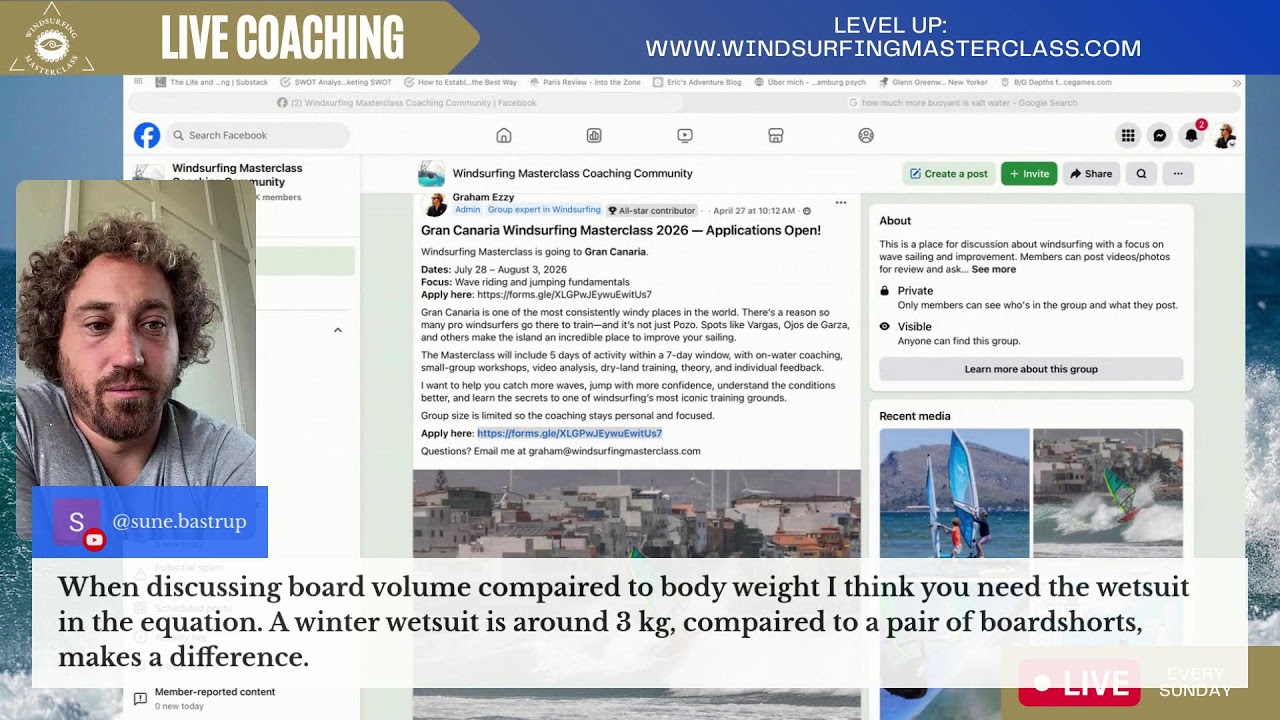
Windsurfing board volume, typically measured in liters, offers a general guide but is not a precise indicator of flotation or performance. Factors like wetsuit weight, which can add up to 3 kg, and the higher buoyancy of saltwater (approximately 3% more than fresh water) influence a rider's effective weight and the board's actual flotation.
Beyond simple volume, board dimensions such as width and length, along with the distribution of surface area, significantly affect how a board interacts with water and supports the rider. Longer, wider boards, even with the same volume, can feel more stable and float easier. Additionally, manufacturing variations mean that a board labeled with a specific volume might not be exact, highlighting that liters serve as an approximate rather than definitive measure.
"My point, what am I trying to say? Is that it's all a little bit hand-wavy. It's not an exact science."
Windsurfing Board Weight Debate: Light vs. Heavy for Challenging Conditions
The optimal weight of windsurfing boards for challenging conditions and intermediate sailors is a subject of debate. While lighter production boards offer significant maneuverability advantages for experienced professionals, a heavier board can provide greater stability and a more 'planted' feel in turbulent, choppy, and overpowered conditions.
For some intermediate riders, a heavier board might prevent wipeouts by resisting being blown around by strong winds, offering a sense of security and control. Ultimately, the best board weight depends on individual preference, skill level, and the specific conditions a sailor frequently encounters.
"When it's really windy, is a light board a disadvantage? I think for a better for the pro level, it's not. It still is an advantage because it's just easier to move around."
Windsurfing Coach Advocates Straight Aerials for Beginners
For windsurfers looking to master aerial maneuvers, starting with straight aerials rather than complex 'tweaked' aerials is the recommended approach. This technique focuses on proper positioning and utilizing the wave's power for propulsion.
- Aim Far Down the Line: Target a point significantly farther down the line than initially perceived, almost in front of the wave, to create a wider arc for takeoff.
- Maintain a Stiff Body: Avoid pushing off the wave, instead keeping the body stiff to remain connected to the wave's power and speed.
- Keep Sail Open: Ensure the front hand keeps the sail open and filled with wind to maintain control during the maneuver.
This method allows the wave's energy and the rider's speed to launch the board, preventing premature spins and facilitating a more controlled progression.
"If you want to really get into aerials, I think going for the straight aerial is the way to start."
Summarised from Graham Ezzy · 37:06. All credit belongs to the original creators. Windsurfing Class summarises publicly available video content.