Original source: Graham Ezzy
This video from Graham Ezzy covered a lot of ground. Streamed.News selected 4 key moments and summarises them here. Everything below links directly to the timestamp in the original video.
Understanding how freestyle moves translate to wave riding can unlock new approaches to improving your windsurfing technique, making practice more versatile.
Windsurfing's 'Shove It' Maneuver Enhances Backside Wave Riding Skills
Learning the freestyle 'shove it' move directly improves backside wave riding, including off-the-lip maneuvers and aerials, according to expert Graham Ezzy. The 'shove it' teaches crucial sail control, specifically how to manage backwinded positions and generate pop from the sail. This skill translation means that practice with the 'shove it' significantly boosts performance in backside wave riding, regardless of whether it's performed in freestyle or wave conditions.
This connection highlights how seemingly distinct windsurfing disciplines share fundamental mechanics, offering a cross-training approach for skill development.
"Shove its are 100% the best way to improve your backside riding because it teaches you how to get the sail down, how to get the sail back winded, and how to get that pop out of the sail."
Expert Recommends Fin and Mast Adjustments for Improved Bottom Turns
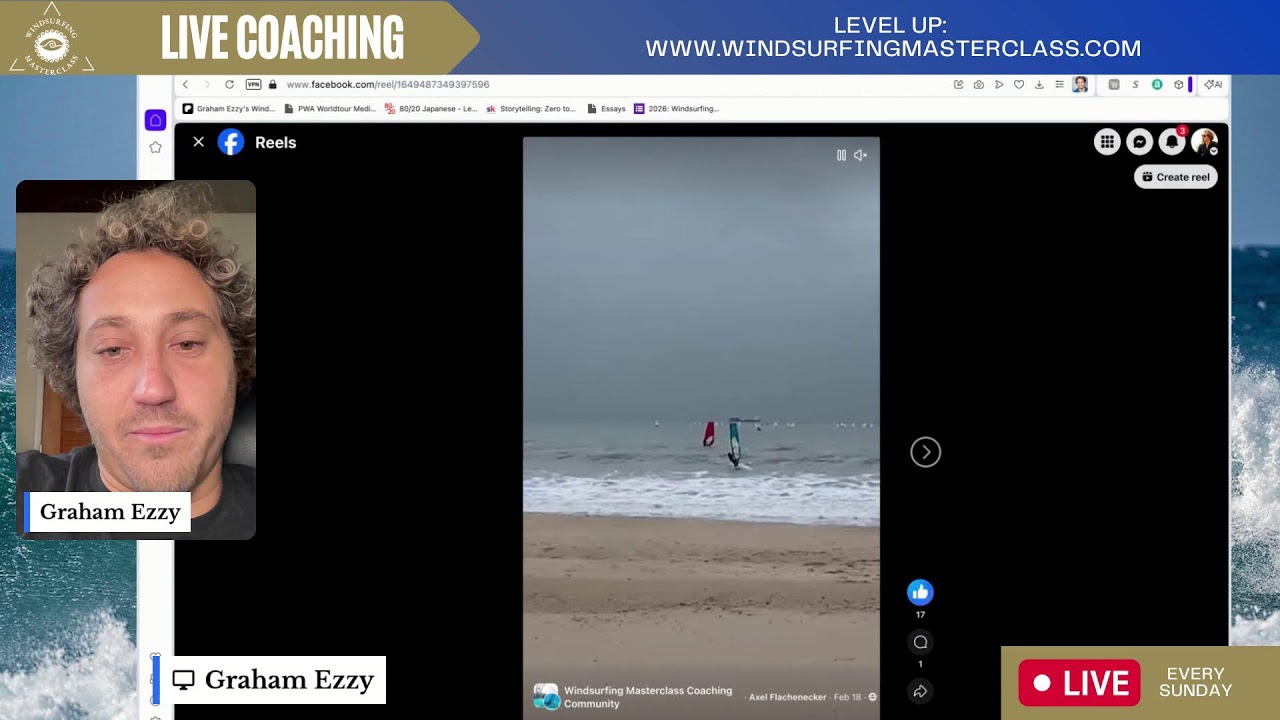
Matteo's windsurfing technique for bottom turns can be enhanced by reducing the delay between dropping into a wave and initiating the turn. This adjustment helps maintain speed and execute tighter turns, crucial for navigating complex wave sections. Additionally, fin and mast track configurations play a significant role in engaging the board's rail effectively.
To optimize performance, expert Graham Ezzy suggests specific adjustments: 1. Fin Size: Change the rear fin to an 18 K4 Scorcher, especially given Matteo's weight, as a 19 cm fin can be too large for easy initiation. 2. Mast Track: Experiment with moving the mast track position forward or backward to better engage the board's rail during turns.
These modifications aim to facilitate an earlier and more powerful bottom turn, particularly on Matteo's Quattro Pyramid board.
"My recommendation is that you want to have a 17 or 18 K4 Scorcher in the rear, and then you want to play with your mast track positioning."
Optimizing Wave Riding Timing and Fin Selection for Capu Manu Waves
For wave riding at Capu Manu, where waves often feature a single, crucial section, precise timing is paramount. Hitting the wave's peak at the opportune moment is essential for executing powerful turns and maximizing the ride. Incorrect timing, such as engaging too early, can lead to suboptimal positioning and missed opportunities.
Expert Graham Ezzy offers specific recommendations: 1. Fin Recommendation: Consider replacing the MFC 19 rear fin with a K4 Scorcher, which is softer and generally preferred for thruster setups to facilitate turn initiation. 2. Timing Adjustment: Aim to hit the wave's peak when it is steepest and most powerful, rather than too early or too late, to enable a committed bottom turn.
These adjustments are critical for leveraging the unique characteristics of Capu Manu's waves.
"When a wave has just one main section like this, the timing becomes so much more important than it normally is."
Fin Recommendations and Maneuver Breakdown for Windsurfers
Windsurfing expert Graham Ezzy advises Matteo, who weighs 84 kilograms, to use an 18 Scorcher fin to enhance board rail engagement. Ezzy also demonstrated a duck tack, a non-scoring but enjoyable transition move accessible to intermediate sailors on larger boards with smaller sails.
The duck tack involves a specific sequence of actions: 1. Foot Switch: Switch feet first. 2. Sail Throw: Throw the sail diagonally forward towards the water and board nose. 3. Boom Catch: Catch the boom at the clew with the back hand. 4. Pull Back: Pull the boom hard towards the tail to re-engage the sail.
Ezzy also noted that back loops can be learned from small chop, offering an alternative for those without large waves, though wave-based learning is preferred for mastering the finesse needed for higher jumps.
"The trick with [duck tacks] is you switch your feet first, and then you throw your sail forward."
Summarised from Graham Ezzy · 38:30. All credit belongs to the original creators. Windsurfing Class summarises publicly available video content.