🌐 Also available in: 🇫🇷 Français
Original source: Iron Will Tennis
This video from Iron Will Tennis covered a lot of ground. Streamed.News selected 4 key moments and summarises them here. Everything below links directly to the timestamp in the original video.
To attack a weaker serve, position yourself inside the baseline and split step forward at an angle. This allows you to intercept the ball earlier and take immediate control of the point.
Return Strategy: Choosing Between Neutral and Aggressive Court Positions
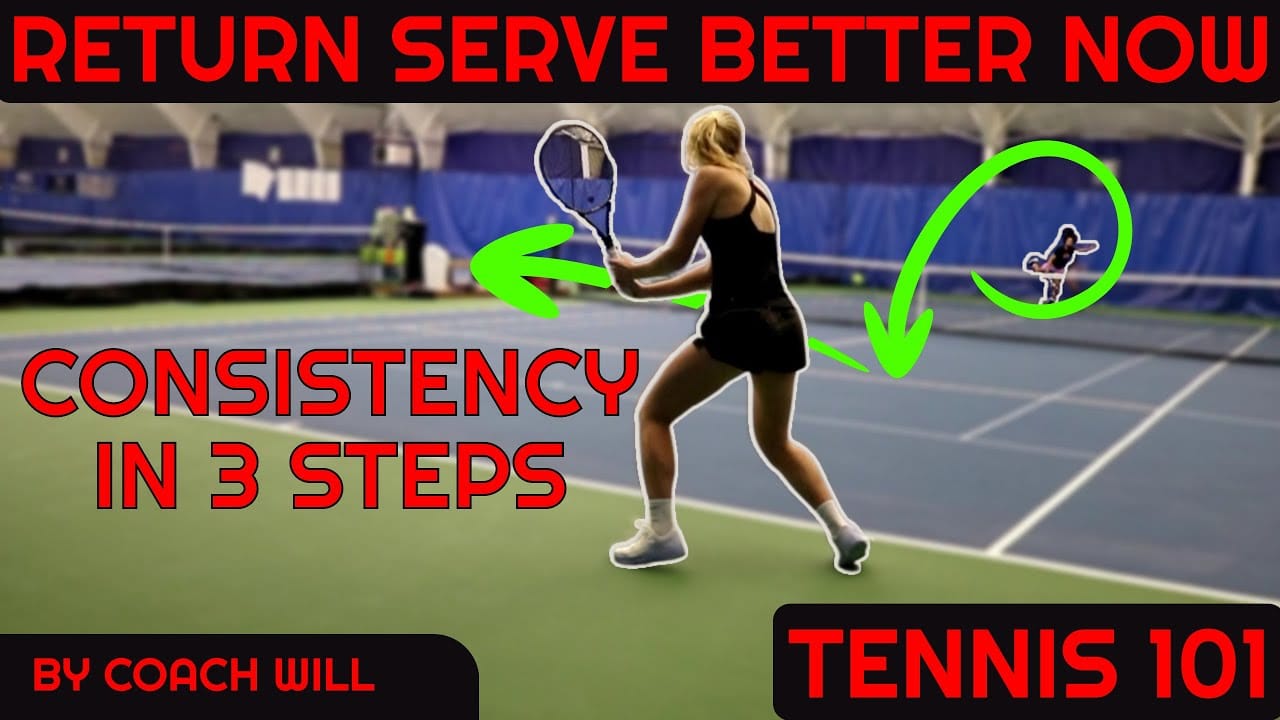
Players can choose between two primary return positions based on their strategic intent. A neutral stance, taken from a standard position, utilizes a split step and a compact swing to consistently neutralize the serve and begin the point. For a more offensive approach, the player should move inside the baseline and angle their split step forward to intercept the ball earlier.
The aggressive positioning is particularly effective against wide serves, as it geometrically cuts off the angle and reduces the distance the returner must cover. This tactic allows the player to take time away from the server and immediately apply pressure, often forcing a defensive response.
"Because I was closer and she served out wide, cutting off the angle was only one step away rather than being stretched all the way out if I was at the baseline."
How to Counter High-Velocity Serves: The Block Return vs. Retreating
When facing a fast serve that reduces reaction time, a player has two primary tactical options. The first is to employ a chip or block return from a closer court position, using a continental grip and a minimal swing to redirect the incoming pace. This technique prioritizes getting the ball back in play when a full swing is not possible.
Alternatively, a player can retreat further behind the baseline to create more time and space. This added distance allows for the execution of a more complete, powerful groundstroke, but it necessarily cedes court position to the server at the start of the point.
"Because I backed up enough, that gave me enough time to still execute a pretty solid full swing with that extra time that I gave myself."
A Three-Tiered Framework for Selecting the Correct Return Swing
The return of serve can be organized into three distinct swing types, with the choice depending on the speed and quality of the incoming ball. For slow, easily handled serves, a player can use their normal full groundstroke motion. For moderately difficult serves, a shortened swing that eliminates the larger take-back is required to save time while still generating pace.
The main determining factor is time. For the fastest serves where time is most limited, the optimal choice is a block or chip return using a continental grip, which relies almost entirely on redirecting the opponent's pace.
"If the ball is coming at you that fast, you can feed off the pace even more and with an open racket face you don't even need the lifting part of the shorten motion."
The Return Split Step: Why Forward Momentum Is a Non-Negotiable
Proper footwork on the return of serve is fundamentally different from a baseline rally. A player should begin with a moderately wide base to enable a quick, explosive first step. The critical distinction is that the split step must be directed forward into the court, rather than vertically up and down as one would do from the baseline.
The reason for this forward movement is to generate body momentum into the shot. This action allows the player to use a more compact swing—essential for reacting to a fast serve—while still hitting a heavy, penetrating ball and immediately transitioning from a defensive to an offensive position.
"When we split for returns we actually want to split into the court, which gets our body momentum moving forward."
Also mentioned in this video
- The importance of the return of serve in tennis, highlighting it as a… (0:00)
- The optimal hand grips for returning serve, detailing specific grips for… (0:22)
- Court position for returns is governed by geometry, demonstrating how the… (2:11)
Summarised from Iron Will Tennis · 8:45. All credit belongs to the original creators. Streamed.News summarises publicly available video content.