🌐 Also available in: 🇪🇸 Español
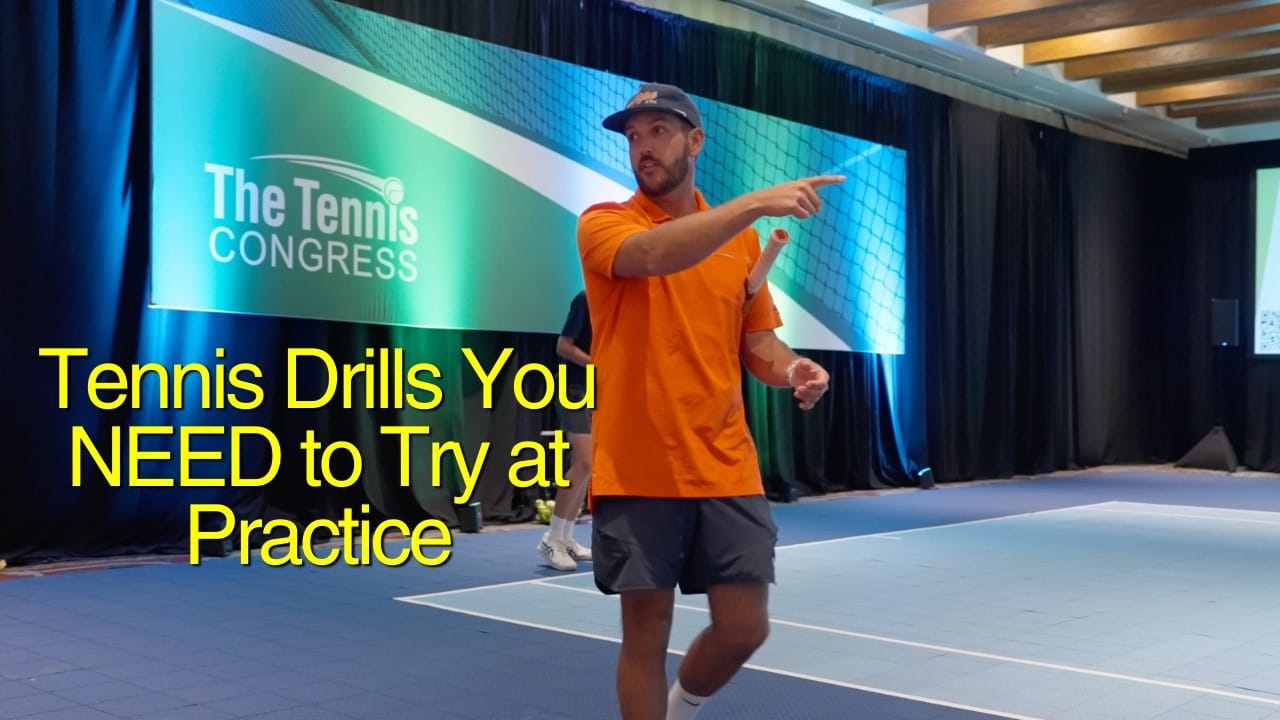
Original source: The Tennis Congress
This video from The Tennis Congress covered a lot of ground. Streamed.News selected 8 key moments and summarises them here. Everything below links directly to the timestamp in the original video.
Most club doubles teams play with one player up and one back. Here's a specific drill designed to systematically exploit the tactical weakness inherent in that popular style.
Coach Recommends 'One-on-One Doubles' Drill to Exploit Common Opponent Weakness
Tennis coach Adam Ford identifies "One-on-One Doubles" as the most crucial drill for players looking to master the serve-and-volley style. The exercise is played on a half-court with doubles alleys active, requiring the server to come to the net after every single serve, both first and second. This format forces repeated practice of the specific attacking sequence needed to be effective at the net in a doubles match.
The drill's strategic value lies in its ability to counter the most common amateur doubles formation: one player at the net and one at the baseline. According to Ford, this setup is the easiest to beat for a team that can get to the net, as it consistently leaves a wide gap down the middle of the court. By forcing the issue, the drill trains players to expose this weakness and pressure the baseline opponent into making errors.
"One up, one back is so easy to beat if you have the ability to serve and volley... there is a gap down the middle every single point, you just got to find a way to get up there."
'One-on-One Doubles Version Two' Drill Forces Players to Attack Second Serves
A variation on the "One-on-One Doubles" drill introduces a specific rule to address a common tactical error in returning serve. In "Version Two," the server must still serve-and-volley on the first serve. However, on a second serve, the responsibility shifts to the returner, who is required to attack the return and immediately move forward to the net.
This modification is designed to correct the tendency of players to passively return second serves. Coach Adam Ford argues that a second serve is, by its nature, a "short ball" that is slower, higher-bouncing, and often has more spin. This drill forces players to reframe the second serve as an opportunity to attack and take control of the point, rather than simply putting the ball back in play from the baseline.
"A second serve is a short ball, right? Why aren't we attacking? So this forces that situation where now, as a second-serve returner, you got to come in."
Tennis 'Horse' Drill Turns Serve Practice into a Precision Targeting Game
Coach Adam Ford introduces a serving drill modeled after the basketball game "H.O.R.S.E." to improve accuracy and make practice more competitive. The court is divided into six numbered zones, and a player must call out which zone they are targeting before serving. If they successfully hit the target, their opponent must replicate the shot exactly or receive a letter, with the goal of not spelling out the full word.
This format introduces accountability and fun to the often monotonous task of practicing serves. A more advanced variation requires players to also call out the type of spin they will use—using simple codenames like "Sam" for slice, "Fred" for flat, or "Ken" for kick. This forces the development of a full range of serves and encourages hitting specific locations with clear intent, rather than just hitting serves aimlessly into the service box.
"It just adds a way for us to actually have some fun while we're serving. Accuracy is super important, it sets up ourselves in the point, so why not have a game where we can actually you know go out with a friend and make it a little competitive?"
'Serving with Exit Targets' Drill Teaches Players to Control the Second Bounce
A more advanced serving drill, "Serving with Exit Targets," reframes the goal of the serve from simple placement to strategic opponent manipulation. In this variation of the "Horse" game, players do not call out where the serve will land in the box, but rather where the ball will exit the court after its bounce. This requires a deeper understanding of spin and trajectory.
This drill forces the server to think about how to pull the returner far off the court, creating an open space for the next shot. It is a subtle but significant shift in mindset, teaching players to plan one shot ahead and use the serve as a weapon to dictate the point's geometry from the very first ball, rather than just starting a neutral rally. The focus moves from where the ball lands to where the opponent is forced to move.
"Now we're thinking about where are we pulling our opponent rather than where the ball is landing with the serve... thinking about the bounce and where the ball crosses the baseline."
'Cuban Davis Cup' Drill Isolates Transition Volleys for High-Repetition Practice
The "Cuban Davis Cup" drill is designed to generate a high volume of practice on transition volleys—the shots hit while moving forward to the net. In the drill, one player continuously feeds the ball while the other starts in the mid-court and plays out the point, focusing on handling low and difficult volleys on the approach. Players switch roles after one person reaches 15 points.
The drill’s effectiveness comes from isolating a single, critical skill that occurs too infrequently in a standard match to allow for rapid improvement. While a player might only hit a few transition volleys in an entire set, this drill allows for dozens of repetitions in minutes. This targeted practice is crucial for developing the feel and touch required for a successful serve-and-volley or all-court game. The drill is named for the heritage of coach Jorge Capistan*.
"If you say 'I want to get better at serving and volleying,' we don't necessarily need to go out and just play more sets... what we need is drills to actually help us out with these and get more touch on the ball with that specific shot."
'Stuck' Drill Trains Players to Hit Deep Volleys from Mid-Court
The "Stuck" drill improves a player's ability to handle being caught in "no man's land," the area between the service line and the baseline. Two players start in this zone and must volley the ball back and forth in the air. The rally becomes a live, attackable point only after one player hits a volley short enough for it to bounce. The player who hit the short ball is then at a significant disadvantage.
The drill's objective is to teach players how to hit deep, penetrating volleys—what coach Adam Ford calls a "60-foot volley"—from an awkward court position. By rewarding the player who can keep their opponent pinned back with deep volleys, it reinforces the idea that the mid-court should be a "one and done" transition zone, not a place to get trapped in a defensive exchange.
"I don't really refer to it as no man's land very often, I call it 'one and done'—is that I should hit one shot in there and then I should get out. But a lot of times we get stuck."
'Mini Tennis' Drill Hones Touch and Control with Slice Shots in Service Boxes
Coach Adam Ford recommends "Mini Tennis" as a drill to develop touch, control, and strategic thinking. The game is played entirely within the confines of the two service boxes, with players primarily using slice shots and a continental grip. While volleys are permitted, they must be hit with touch and aimed upward, preventing players from ending points with aggressive, downward smashes.
The exercise forces players to rely on finesse rather than power, sharpening their ability to create angles, control the ball's spin, and place it precisely. This emphasis on touch is particularly beneficial for doubles, where soft hands at the net and the ability to hit deft angled volleys are critical skills. Ford notes that warming up with this drill can lead to surprisingly dominant doubles performances by priming a player's feel for the ball.
"We played the best doubles of our life because we started out with just all touch skills... we're just having fun and then all of a sudden we go out and we just dominate in doubles."
'Bum Rush' Drill Forces Hesitant Players to Approach the Net on Short Balls
The "Bum Rush" drill is designed to help players identify and act on opportunities to move to the net. During a full-court point, a simple rule applies: if a player hits any shot that lands inside the opponent's service line, they must immediately rush forward and approach the net. This removes the hesitation often associated with deciding when to attack.
This drill is particularly useful for baseliners who are uncomfortable at the net or unsure which shots merit an approach. By forcing the action, players get numerous repetitions and begin to learn through experience which short balls are effective to attack and which are "dumb shots to come in on." It builds the instinct to move forward, transforming a passive player into one who actively looks to finish points at the net.
"This drill is really meant for the people that don't come into the net. They don't have that experience or they don't know what the right shot is to come in on, so we just get you coming in."
Also mentioned in this video
- His 'Purposeful Practice' presentation, also known as 'The One-on-One Workout,'… (0:00)
- The first drill for singles, a half-court crosscourt game up to 11 points,… (2:02)
- The second drill as the same half-court crosscourt on the ad side, and then… (6:01)
- Adam Ford details the 'One-on-One Singles Plus' drill, which eliminates the… (13:35)
- Adam Ford transitions to doubles drills, starting with the Cuban Davis Cup… (21:28)
- The third doubles drill, a 'gang fight' in half a court, straight ahead, where… (22:57)
- The 'One-on-One Bum Rush' drill for doubles, a crosscourt game where players… (28:21)
Summarised from The Tennis Congress · 36:53. All credit belongs to the original creators. Streamed.News summarises publicly available video content.