🌐 Also available in: 🇪🇸 Español
Original source: The Tennis Congress
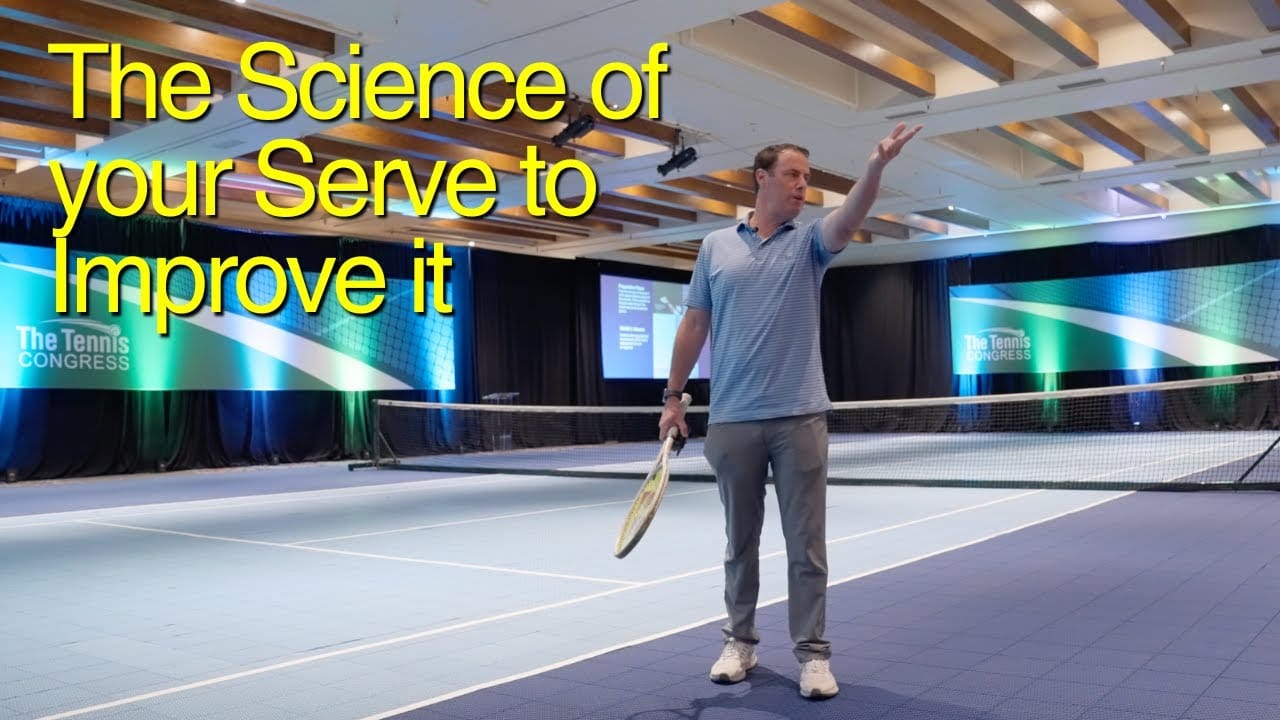
This video from The Tennis Congress covered a lot of ground. Streamed.News selected 8 key moments and summarises them here. Everything below links directly to the timestamp in the original video.
Struggling with your ball toss? A leading coach explains that the solution lies in three simple fundamentals: keeping your arm straight, releasing near eye level, and aiming for the far net post.
Coach Reveals Three Keys to a Consistent Tennis Serve Ball Toss
For a more consistent ball toss, players should focus on three fundamental mechanics, according to biomechanics coach Mark Kovacs. The first is to keep the tossing arm as straight as possible to reduce the number of moving joints and decrease variability. The second is to release the ball within a narrow window, between eye level and the top of the head. The third key is to direct the tossing arm towards the opposite net post—for a right-hander, this means aiming the left arm toward the right net post.
These three principles create a reliable foundation for the entire service motion. Releasing the ball too low forces a player to chase it forward, while releasing it too high can send it behind them. Aiming the arm toward the side, rather than straight at the net, allows the hips and shoulders to stay coiled, preserving rotational energy for the swing. By focusing on these fundamentals, players can eliminate common errors and distinguish repeatable mechanics from personal stylistic quirks, such as how Serena Williams held the ball.
"Every good server is in a very narrow window of release. It's between the eyes and the top of the head. If you release it too low, what happens? It gets out in front of you and you're chasing. If you release too high, it typically goes left or behind you."
To Improve Your Serve and Avoid Injury, Focus on Cause Over Effect
Tennis players should focus on the root causes of their service motion rather than the visible effects, advises coach Mark Kovacs. He identifies several core principles for a powerful and safe serve, including distinguishing personal style from universal fundamentals, using ground reaction forces effectively, and maintaining proper body alignment. A key element of this alignment is staying “side-on” to the net for as long as possible before making contact with the ball.
This side-on position is crucial for injury prevention. When players open their hips and shoulders toward the net too early, their body must compensate by collapsing to the side, putting excessive pressure on the lower back, abdominals, shoulder, and elbow. Kovacs notes that some of the game's most powerful and durable servers, like Pete Sampras and John Isner, maintained excellent alignment, which protected their arms despite hitting countless high-velocity serves over their careers.
"If I open up too early, way before contact, my shoulders and my hips start facing the net... That's when you start putting a lot of pressure on your lower back, on your abdominals, and especially on your shoulder and your elbow."
Tuck Your Non-Hitting Arm to Unlock Explosive Power on Your Serve
To generate maximum racket acceleration on the serve, players should focus on pulling their non-hitting arm into their body, says coach Mark Kovacs. The key is to maintain a “side-on” posture as long as possible, with the chest pointing toward the side fence. As the hitting arm swings up to the ball, the non-hitting arm should be drawn tightly in toward the belly button, creating a locked-in position.
This movement is not just for show; it serves a critical biomechanical purpose. Tucking the arm creates a powerful counter-force that provides balance and allows the torso to rotate more explosively through the hitting zone, a principle also seen in baseball pitching and boxing. When players let their non-hitting arm fly open, their body leans away from the contact point, causing them to lose both power and control while placing unnecessary strain on the hitting shoulder.
"Anytime we've got a high-force action, you've got an opposing force on it for balance. To be able to come through very explosively this way, we need a counter-force to balance us so we don't fall flat on our face."
Tennis Coach Debunks One of the 'Worst Cues in the History of Serving'
Biomechanics expert Mark Kovacs debunks the common coaching instruction to “stick your front hip out” on the serve, calling it one of the worst cues in tennis history. He clarifies that the front hip moving over the baseline is an effect, not the cause, of a proper load. The correct fundamental action is to drop the body’s weight down and back into the rear hip while adding a slight coil of 10 to 15 degrees.
The incorrect cue, which became popular from people observing Pete Sampras in the 1990s without understanding the underlying mechanics, led to a generation of flawed servers. Forcing the front hip out shifts all the player's weight onto the front leg, which prevents the back leg from loading energy. The proper loading of the back hip allows a player to drive up and forward into the court at approximately a 45-degree angle, creating an efficient transfer of power from the ground up.
"That is, unfortunately, the worst coaching queue in the history of serving: stick your front hip out... The weight was going back and down into the back hip. As a result, the front hip did go forward, but that wasn't the cause. That was the effect."
Correct Hip Position Can Automatically Fix Elbow Flaws in a Tennis Serve
The most critical loading moment in the tennis serve occurs when the hip reaches its lowest point, storing maximum energy in the lower body. According to coach Mark Kovacs, mastering this position—by dropping the back hip low with a slight 10 to 15-degree rotation—is a fundamental that can automatically correct flaws elsewhere in the motion.
This highlights the principle of cause and effect in biomechanics. Many players are coached on upper-body issues, like an elbow that is too high or too low, without addressing the root problem. Kovacs explains that these are often just effects of improper hip loading. When the hips drop and coil correctly, the torso is positioned properly, which in turn allows the hitting elbow to naturally fall into its ideal alignment. By fixing the cause in the lower body, the upper-body effects often resolve themselves.
"If you're trying to fix an elbow issue, be clear: are you fixing the elbow, or do you need to fix the hip position first? Too many times we're trying to solve for an effect, we're not solving for the cause."
Serve Speed Depends on Hip Velocity, Not Depth of Knee Bend
The key to generating high velocity on a tennis serve is not the depth of a player's knee bend, but the speed at which their back hip moves upward. Biomechanics expert Mark Kovacs states that while loading the legs is crucial, the single most important factor is the velocity of the hip's vertical movement, from its lowest point in the load to its highest point during the upward drive.
Professional player Nick Kyrgios serves as a prime example of this principle. Kyrgios does not use a particularly deep knee bend compared to some of his peers, yet he possesses one of the fastest serves in history. His power comes from the incredible speed at which he explodes out of his relatively shallow load. This demonstrates that simply trying to bend the knees more, without the ability to generate explosive upward velocity, is an ineffective strategy for increasing serve speed.
"It's the velocity of the hip, it's not the distance of the hip... Nick Kyrgios is a good example. He doesn't have a great distance in his knee bend. He has unbelievable velocity, though."
An Elite Tennis Serve Requires Jumping Forward, Not Just Straight Up
The jump in a high-performance tennis serve is not a purely vertical motion, but rather an explosive drive that moves the body forward into the court. According to coach Mark Kovacs, the proper mechanics involve loading the body back and down in order to launch up and out. This allows a player to make contact with the ball well inside the baseline, maximising both power and angle.
A common error is to jump straight up, which disrupts the kinetic chain. If the lower body only moves vertically, the upper body is forced to collapse forward to reach the ball, resulting in a loss of power and increased risk of injury. Achieving the ideal upper-body position during this complex movement is physically demanding, often limited by a player's thoracic spine mobility and shoulder flexibility, which can decrease with age or injury.
"We actually want the body to go back and down so that it comes up and out, because we want to make contact out here. We don't want to make contact up here."
Two Key Factors Predict Tennis Serve Speed, Biomechanics Data Shows
According to repeated biomechanical studies, two specific movements have the strongest correlation with tennis serve speed. The first, and most important, is the vertical displacement velocity of the back hip. This measures how quickly a player’s rear hip travels from its lowest point during the loading phase to its highest point at extension, effectively quantifying the power generated from the ground.
If that initial leg drive is slow, the entire sequence of force transfer, or kinetic chain, is compromised. The second major factor is the speed of “long axis rotation,” a technical term for the rapid rotation of the entire hitting arm. This movement combines internal shoulder rotation with forearm pronation through the contact zone. Improving the speed of both the hip drive and the arm’s rotation is the most direct way for any player to increase their serve velocity.
"The speed that the back hip goes vertical... is the most important factor, actually more than anything else, because if that doesn't happen right, then you have to make up for that lack of velocity in other parts of your body."
Also mentioned in this video
- His presentation on the tennis serve, emphasizing the difference between… (0:00)
- Players should be realistic about what they can accomplish with their serve,… (0:53)
- The discussion focuses on the scientific research behind serve fundamentals,… (1:40)
- Kovacs details the development of an eight-stage model for the tennis serve,… (3:05)
- The discussion delves into the importance of how quickly a player comes out of… (8:15)
- The significance of landing inside the court as an indicator of proper body… (16:28)
- The common issue of players compromising body position to make contact, leading… (23:19)
- The common question of toss height, clarifying it's a stylistic element with… (29:38)
- Kovacs clarifies that turning the palm up during ball release is a result of… (41:51)
- The discussion focuses on long axis rotation, highlighting that restricted… (43:52)
- Kovacs concludes by stating that while the serve's finish is irrelevant for… (47:20)
Summarised from The Tennis Congress · 48:33. All credit belongs to the original creators. Streamed.News summarises publicly available video content.