🌐 Also available in: 🇫🇷 Français
Original source: Iron Will Tennis
This video from Iron Will Tennis covered a lot of ground. Streamed.News selected 6 key moments and summarises them here. Everything below links directly to the timestamp in the original video.
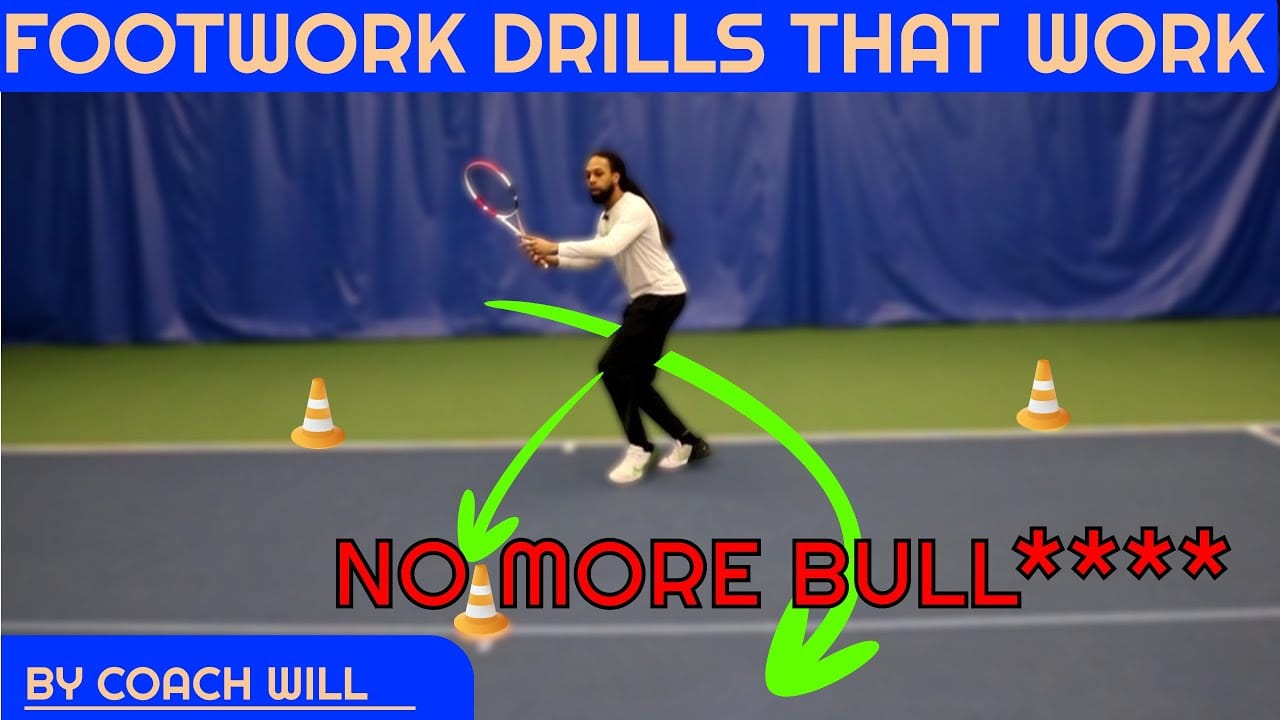
This single drill trains the three core movement scenarios—short, long, and forward—to build the adaptive footwork required for match play.
Comprehensive Footwork Drill Integrates Shuffles, Crossovers, and Spacing Adjustments
A final, variable drill combines creating and covering space by forcing players to adapt their movement to cones placed at different distances. To reach a nearby cone, a player uses small shuffles; for a wide cone, a powerful crossover step is required; and for a forward cone, the player must circle around it to create hitting space. This sequence integrates all previously learned movements into one dynamic exercise.
The purpose of this controlled variation is to mirror the unpredictability of a real match. By forcing constant adjustment between different footwork patterns, the drill trains a player’s ability to think and react, ensuring they are prepared for the slight differences in every incoming shot.
"No shot comes to you the same so you always want to be prepared for a slight amount of variety every time."
Drill Develops Explosive First Step for Covering Lateral Distance
A fundamental drill for covering lateral space focuses on developing a powerful first step. The sequence begins with a split step, followed immediately by a large, explosive front crossover step to move toward a wide ball. This single movement is designed to cover maximum ground and position the body correctly for the ensuing shot.
The objective is to practice this pattern until it becomes subconscious. Through repetition, a player can improve the dynamic quality of the movement, making their reaction to wide shots faster and more automatic, which is essential for effective court coverage.
"Get your feeling of getting these movements to be a little bit more subconscious."
Footwork Drill Teaches Aggressive Positioning and Efficient Recovery
To effectively take the ball early, a player must master not only the approach but also the recovery. This drill trains players to step forward into the court, pivot their weight through the shot using the opposite leg as a brace, and then execute a quick back crossover step to return to the ready position. A key technical focus is maintaining a constant body level, avoiding unnecessary up-and-down movement.
This sequence is critical for an aggressive game style, as it allows a player to attack short balls and take time away from an opponent without being left out of position for the next shot.
"You want to drop your level right from the split step, get into this position here, and then just push your body weight out into the shot."
Drill Trains Back Crossover Step to Create Hitting Space
The first footwork exercise focuses on creating space when a ball is hit directly at the body. From a ready position, the player executes an explosive split step and immediately performs a back crossover step. This action serves two purposes: it moves the body out of the ball's path to create adequate hitting distance and simultaneously rotates the hips into the correct position to execute a groundstroke.
This specific footwork pattern is crucial for handling pace and depth effectively. It allows a player to turn a potentially defensive situation into an offensive opportunity by manufacturing the necessary space and body preparation for a full swing.
"...you're not only getting out the way but you're also rotating your body to make sure that it'd be possible to hit a shot."
Forward Movement Drills Differentiate Offensive and Defensive Approaches to Short Balls
Approaching a short ball requires different footwork depending on tactical intent, a distinction addressed by two drill variations. For a defensive response, such as a slice, the player moves forward and drops into a small lunge, absorbing the landing with the front leg. For an offensive shot, the player instead absorbs the landing and then stands up into the shot, driving through the ball with upward momentum.
This differentiation is critical for proper shot execution. It trains a player to instinctively adjust their body level and weight transfer based on whether they are neutralizing a difficult low ball or attacking a weaker short ball.
"That's going from getting to the ball kind of defensively to get into the ball offensively."
Footwork Drill Blends Crossover and Shuffle Steps for Precise Positioning
To cover medium-to-long lateral distances with precision, players must seamlessly transition between different footwork patterns. This drill trains that skill by requiring a player to initiate movement with a large crossover step, which covers the most ground quickly. As the player nears the ball, they must then switch to smaller shuffle steps for the final micro-adjustments to achieve optimal spacing.
The main determining factor on how to approach a shot is distance. This exercise specifically addresses the common need to cover 8-9 feet, where a crossover provides the initial velocity and shuffles provide the necessary control for contact.
"What we do is get the feeling of being able to seamlessly go between big steps and small steps quickly."
Also mentioned in this video
- The importance of relevant footwork drills in tennis for improving movement to… (0:00)
- Every footwork drill serves one of two purposes (0:44)
- The presenter dismisses the use of footwork ladders for tennis-specific… (1:37)
- The video concludes by reiterating the effectiveness of basic, relevant… (11:15)
Summarised from Iron Will Tennis · 12:46. All credit belongs to the original creators. Streamed.News summarises publicly available video content.