🌐 Also available in: 🇪🇸 Español
Original source: The Tennis Congress
This video from The Tennis Congress covered a lot of ground. Streamed.News selected 6 key moments and summarises them here. Everything below links directly to the timestamp in the original video.
If your serve feels like a simple push, this drill is the first step to unlocking power. It retrains your arm to use pronation by leading with the racket's edge.
First Drill for a Modern Serve Focuses on Racket Edge and Pronation
A tennis coach introduced the first of three drills designed to rebuild a serve with modern fundamentals. Players start inside the service line with a continental grip, choked up on the racket so the buttcap faces up. From this position, which mimics the racket drop, the player tosses the ball and focuses on leading with the edge of the racket, keeping it to the right side of the ball during the upswing. The goal is to feel the racket next to the ball before turning the strings into it at the last moment.
This drill directly combats the common amateur mistake of opening the racket face too early in an attempt to simply get the ball in the court. By consciously leading with the edge, players train their brain and muscle memory to delay this action. This technique properly engages forearm pronation through contact and into the follow-through, which is a critical component for generating both power and spin on the serve.
"I want to feel like my racket is next to the ball. Then I can turn it this way."
How to Stabilise Your Tennis Serve by Fixing the Ball Toss
To create a more consistent ball toss, a tennis coach advises players to eliminate all extraneous movement and maintain good posture. The ball should be held gently in the fingers, like a glass of water up to the second knuckle, which prevents the wrist from engaging and flicking the ball. The tossing motion should be a simple, slow lift of a straight arm, as if a light pressure is being applied from below.
The key to control is to keep the tossing arm elevated after releasing the ball. Many players make the mistake of dropping their non-hitting arm immediately after the release, which destabilises the body and degrades accuracy. By keeping the arm up, players create a stable frame, significantly improving their control over the toss's height and placement, which is the foundation for a reliable serve.
"Hold the ball more like a glass of water where you're less likely to engage your wrist. And simply just lift the arm up... and keep the left arm up. You'll be surprised how much more control you have."
Internal Shoulder Rotation Accounts for 40% of Serve Power, Coach Explains
The acceleration phase of the tennis serve, from the lowest point of the racket drop to contact, is responsible for approximately 40% of the serve's power, according to studies by Vic Braden and Dr. Bruce Elliot. This power primarily comes from internal shoulder rotation. To understand this motion, a coach led attendees through a drill: holding an arm out straight and rotating the thumb backward (external rotation) and forward (internal rotation), feeling the movement originate from the shoulder joint.
The same principle applies when the arm is bent at the elbow, but the rotation then originates from the forearm. The combination of shoulder and forearm rotation, known as long axis rotation, is what powers the swing into the ball. By practicing coiling the arm back from a finish position—keeping the wrist neutral to avoid losing tension—players can feel the arm become "spring loaded." This stored elastic energy is then released as the arm extends and uncoils up toward the ball.
"Going from your racket drop into this position here, it's called internal shoulder rotation, is about 40% of your power. So, it's very important."
Palm-Down 'Racket Drop' Is Key to Power and Injury Prevention in Tennis Serve
The "racket drop" is a crucial position in the tennis serve that maximises racket head speed and helps prevent injury, but it is often misunderstood. A coach explained that this position is achieved through a right-to-left arm motion where the shoulder and elbow are aligned and the palm of the hitting hand points down. This palm-down orientation allows the shoulder to remain loose and enables a full range of motion, creating a longer swing path for greater acceleration.
In contrast, many amateur players incorrectly use a palm-up position, which tightens the shoulder, increases stress on the joint, and shortens the swing. The racket drop itself is not a forced pose but a dynamic result of proper mechanics. It happens naturally when a player combines a loose, palm-down arm with disciplined body rotation. As the body rotates forward, the relaxed arm drops into a power loop, gaining speed and momentum before accelerating up to the ball.
"The racket drop to me is a dynamic position. It's a result of all the things going right."
Tennis Coaches Recommend Ad Court Practice to Correct Common Serve Flaws
For a proper serving stance, a coach recommends a slightly side-on position where the front shoulder points toward the net post on the same side of the court. This setup prevents players from being too square to the net or too sideways, allowing for effective body rotation. A common error, especially on the deuce court for right-handers, is opening the body up too early, which causes the swing path to go down and across the body, resulting in a loss of height and shape on the serve.
To combat this tendency, it can be beneficial for players to practice serving from the ad court. This position naturally makes it easier to swing outward toward the target without having to cross the line of the body, discouraging a premature opening of the shoulders. Another useful visualisation is to imagine always serving to a right-handed opponent's backhand. This mental target helps maintain a more extended and upward swing path, promoting better mechanics.
"If you are a little bit side on, your swing can still go upwards and outwards. If I open, it goes down across too early and then you lose shape and height over the net."
Body Uncoiling Naturally Coils the Arm for an Explosive Tennis Serve
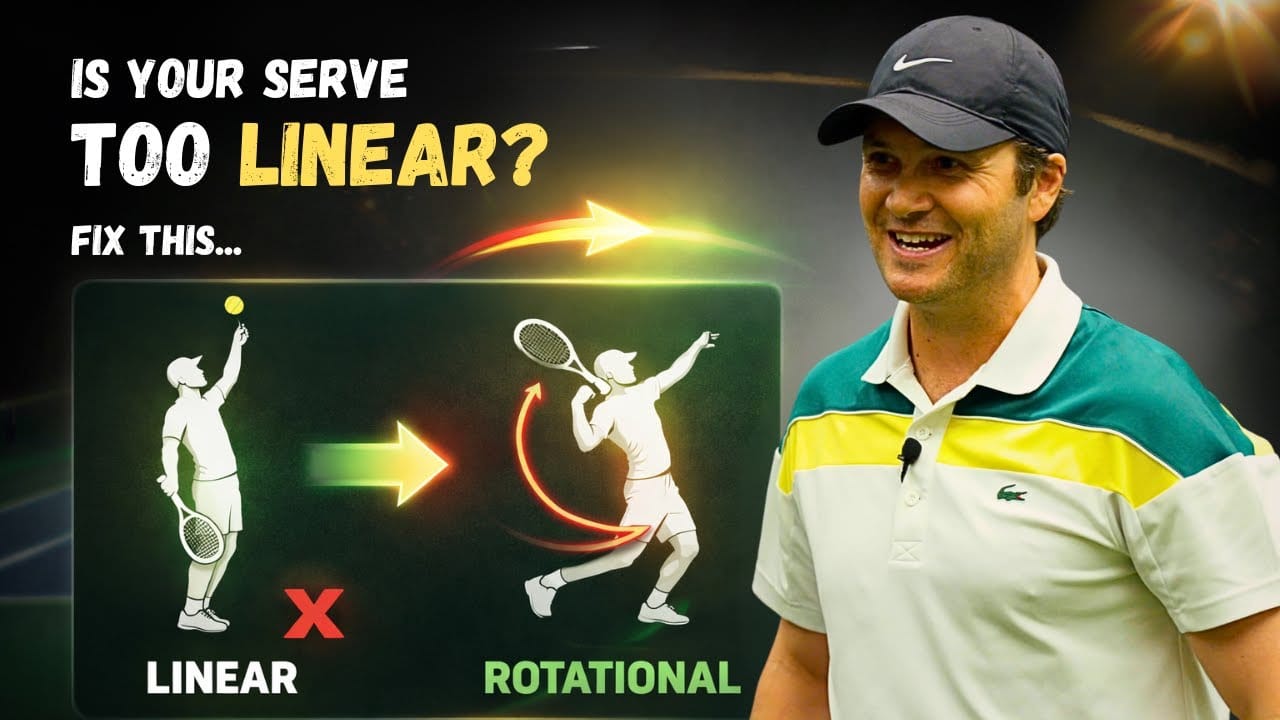
A tennis coach explained the counterintuitive relationship between body and arm movement in the serve: as the body uncoils, the arm coils. This means that as a player drives with their legs and rotates their torso toward the net, this upward and forward momentum naturally causes the hitting arm to drop back and coil, storing elastic energy in the shoulder and chest muscles. This tension is then released explosively as the arm uncoils and accelerates up to meet the ball.
This concept reframes the serve's power source, showing that the arm's action is not isolated but is a direct consequence of the kinetic chain starting from the ground. By focusing on an aggressive leg drive and body uncoiling, a player can create a faster arm coil without consciously trying to force it. This creates a more fluid and powerful motion, much like stretching an elastic band before releasing it, ensuring the arm's acceleration is a reaction to the body's momentum rather than an independent action.
"When our body uncoils, our arm will coil. So when you speed up your body, drive your legs, this coils faster, stretches the muscles... That energy is stored like an elastic band and then releases up to contact."
Also mentioned in this video
- The three main goals for the session on the tennis serve (1:41)
- The presenter begins discussing the lower body's role in the serve, introducing… (4:15)
- The non-hitting arm, explaining how the left hand directs the right hand by… (12:26)
- The second and third serve drills (26:14)
Summarised from The Tennis Congress · 35:02. All credit belongs to the original creators. Streamed.News summarises publicly available video content.