🌐 Also available in: 🇪🇸 Español
Original source: Essential Tennis - Lessons and Instruction for Passionate Players
This video from Essential Tennis - Lessons and Instruction for Passionate Players covered a lot of ground. Streamed.News selected 7 key moments and summarises them here. Everything below links directly to the timestamp in the original video.
Your spin serve works great from the ad side but fails on the deuce side? The problem is your swing angle, and here is the exact adjustment you need to make.
How to Adapt the Spin Serve for the Deuce Court
To execute the spin serve from the baseline, players should first practice on the ad side, using the baseline itself as a convenient guide for the sideways racket path. This position allows for a direct application of the left-to-right swing, creating a natural feel for throwing the racket past the ball.
Transitioning to the deuce side requires a critical adjustment. Because the ball's target is now to the left, the swing path must change from parallel to the baseline to an angle approximately 45 degrees into the court. This change is necessary to maintain the 90-degree cut relative to the ball's trajectory, ensuring consistent spin generation.
"On the deuce side the angle you're going to throw the racket is about a 45 degree angle... because we still want to cut past the ball but relative to the direction the ball is traveling we're now cutting at about a 90 degree angle."
For Serve Accuracy, Adjust the Racket Face, Not the Swing Path
When developing a spin serve, the key to accuracy is manipulating the racket face angle, not altering the swing path. As players move back to no-man's-land, they must continue to execute the sideways swing that produces the distinct "click" sound, which indicates spin. If serves miss the box, the correction must come from small adjustments in how the strings are angled at contact.
Players must resist the powerful temptation to correct misses by swinging forward towards the target. This common error immediately negates the spin-generating path, eliminates the curve, and causes a reversion to an ineffective "patty cake" second serve. True consistency comes from committing to the path and learning to aim with the face.
"Do not try to fix a serve that makes the click but doesn't go in the box by starting to go forward again with your racket. You'll lose the click, you'll lose the spin, you'll lose the curve."
The 'Click' Sound Is the Key to Generating Serve Spin
The primary auditory cue for a correctly executed spin serve is a distinct "clicking" sound at contact. This sound is not produced by hitting the ball hard, but by the racket moving quickly past the ball with a sideways motion. This action causes the strings to grip the ball, shift out of place, and then snap back, creating the audible click.
This sound becomes a player's "North Star" for technique. Hearing the click provides instant confirmation that the swing path is generating spin and curve. Its absence indicates a reversion to a flat, direct delivery where the racket moves through the ball, a motion that offers no spin and a much lower margin for error.
"That quick shift and snap is what creates that clicking sound. If your racket travels through the ball, the strings will not shift, and they will not snap back, and you'll never hear that clicking sound."
Mastering the 90-Degree Swing Path Difference Between Flat and Spin Serves
The foundation of an effective spin serve lies in understanding the distinctly different swing paths required for it versus a flat serve. A flat serve involves a direct, forward delivery of the racket through the ball and toward the net. In contrast, a spin serve requires a sideways delivery, with a swing path that is 90 degrees different, moving across the front of the body.
Using the center service line as an anchor, players can physically train this new motor pattern. This drill is crucial because it teaches the body to throw the racket past the ball, not through it, which is the essential mechanical change needed to generate curve and create a wider margin for error.
"We're trying to throw the racket past the ball instead of throwing the racket through the ball. That's what's going to give us the curve and the spin."
Three Common Mistakes That Sabotage Spin Serve Development
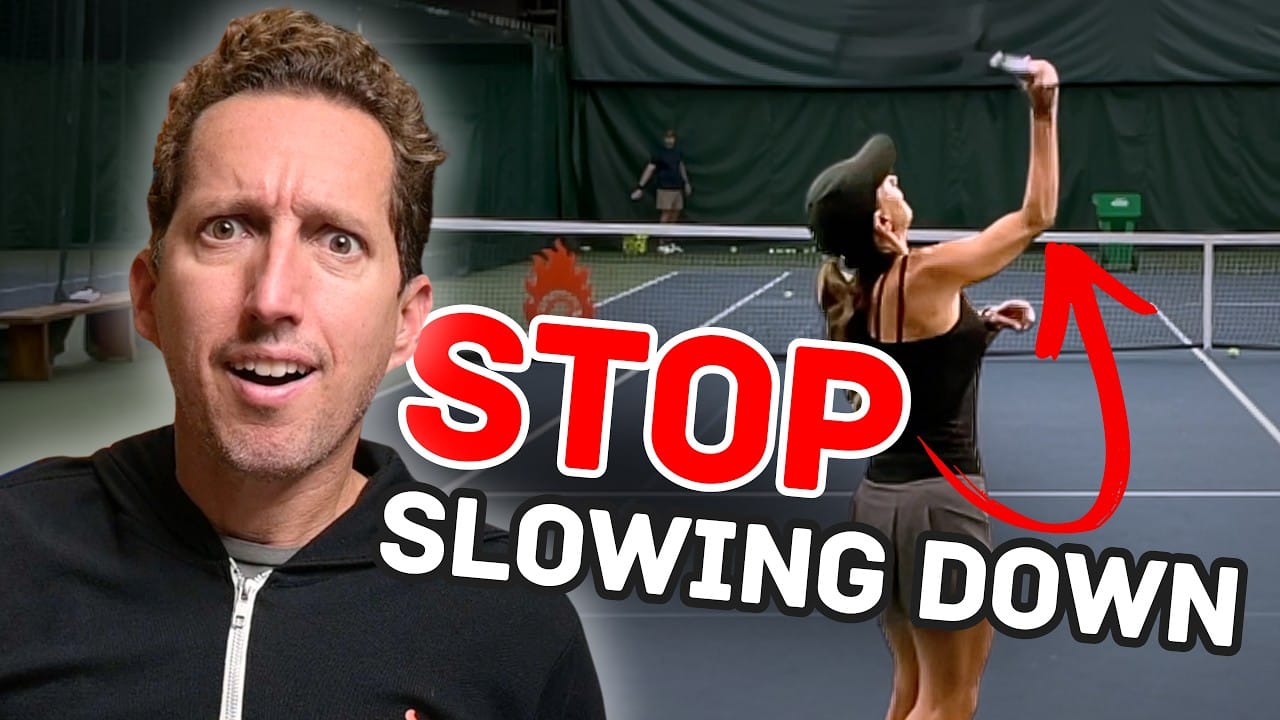
Players learning a spin serve often make three critical mistakes that prevent progress. The first is slowing down after a miss, which defeats the purpose of generating racket speed for spin. The second is reverting to a forward swing path toward the box, a habit indicated by the disappearance of the crucial "click" sound. The third error is changing the swing path to find the box instead of adjusting the racket face.
These mistakes stem from a lack of commitment to the new, counter-intuitive technique. To succeed, a player must fully commit to swinging fast and sideways, using the racket face to aim, rather than falling back into old habits of pushing the ball into the court.
"If the sound starts disappearing you know either you've slowed down or more likely your racket has started going towards the box again and not past the back of the ball."
Why Swinging Faster Makes a Second Serve Safer
The mechanics of a successful serve are governed by a simple principle: "The face sends it, the path bends it." The angle of the racket face determines the ball's initial direction, while the path of the racket's swing generates spin, which in turn creates curve. A flat first serve uses a direct path for power, while a second serve uses a sideways path to create a curve.
This curve is a safety net, revealing a paradox: swinging faster on a second serve is actually better. A faster sideways swing imparts more spin, causing the ball to curve more dramatically. This allows a player to aim higher over the net with more speed, confident the ball will drop into the service box, eliminating the need to be careful.
"Faster is better, because the faster you swing sideways past the ball, the more the ball spins. And the more it spins, the more it curves. And the more it curves, the more safety you have."
A Simple Drill to Build Your Spin Serve: Listen for the 'Click'
To effectively develop a spin serve, players should engage in a focused training drill: hit 20 second serves with the single goal of hearing the distinct "click" sound at impact. During this exercise, the objective is not to make the serve in the box or to aim for a specific target, but solely to produce the auditory feedback of a correct sideways swing.
This single-minded focus simplifies the learning process by isolating the most critical component—the change in swing direction. Once a player can consistently create the click, the foundation for spin is set. From this sound, the development of curve, confidence, and a higher margin for error will naturally follow.
"Go out and hit 20 second serves with one goal. Not to make them in the box, not to aim them or direct them, just hear that click sound."
Also mentioned in this video
- The common mistake of slowing down for a second tennis serve is ineffective and… (0:00)
- Many competitive adult players, like the speaker's student Gina, make the… (0:40)
- Roger Federer's first serve involves a direct hit with his torso facing the… (2:12)
- The instructor demonstrates Gina's second serve transformation, comparing her… (5:53)
Summarised from Essential Tennis - Lessons and Instruction for Passionate Players · 16:42. All credit belongs to the original creators. Streamed.News summarises publicly available video content.