🌐 Also available in: 🇫🇷 Français
Original source: Iron Will Tennis
This video from Iron Will Tennis covered a lot of ground. Streamed.News selected 4 key moments and summarises them here. Everything below links directly to the timestamp in the original video.
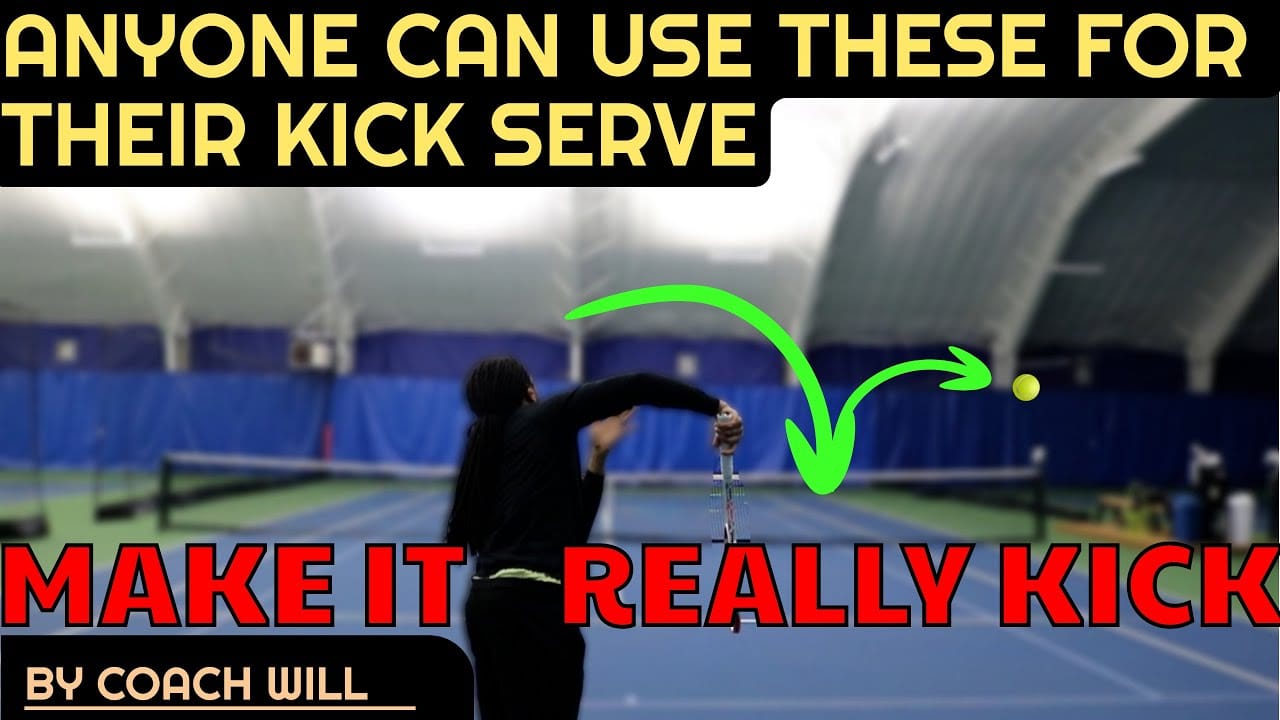
To generate a truly effective kick serve, focus on retracting your serving arm like a swimmer's stroke. This keeps the arm from projecting forward, dedicating its force entirely to the lateral spin that makes the ball jump sideways.
Optimizing Kick Serve Spin with a "Swimmer's Arm" Motion
A critical technique for maximizing lateral movement on a kick serve involves adopting an arm motion analogous to a swimmer's stroke. Instead of extending the arm forward through contact, which creates unwanted projection, the arm should retract and stay close to the body's plane. This isolates the arm's action to generating lateral force, directing its path towards the sideline rather than the net.
The reason this is effective is that it separates the generation of forward momentum from the generation of spin. A slight forward jump provides the necessary projection to get the ball into the service box, allowing the arm to focus exclusively on creating the side-to-side action that makes the ball “kick” aggressively off the court.
"Instead of extending the arm out through the serve, we're going to do that same mechanic of kind of swimming and pulling it back... you can see the arm actually never really passes me."
Hip Drive Parallel to Baseline Key for Kick Serve Angle
To minimize forward projection and maximize lateral snap on a kick serve, the hip drive during the loading phase must be reoriented. Instead of pushing the hip over the baseline towards the net—a motion that loads the body for forward velocity—the hip should be shifted along the baseline. This adjustment changes the body's coil from a back-to-front orientation to a side-to-side one.
The main determining factor here is the direction of the kinetic chain's release. A hip drive along the baseline facilitates a rotational uncoiling, allowing the body to snap from side to side and generate the sharp angle characteristic of an effective kick serve, rather than linear power.
"By shifting my hip along the Baseline instead, it allows my body to snap more from this side to this side rather than snapping from back to front."
Deceive Opponents by Reintroducing Projection to the Kick Serve
After establishing an effective kick serve that moves laterally, a powerful tactical adjustment is to intentionally add forward projection back into the motion. While maintaining the exact same toss, load, and initial visual cues, the server can switch from a brushing, side-on contact to a forward drive through the ball. This creates a topspin serve that looks identical pre-contact.
This tactic exploits the opponent's adaptation. Once the returner begins to anticipate the lateral bounce and prepares to move sideways, the unexpected forward-bouncing serve will jam them, leading to a weak return as they are caught moving in the wrong direction.
"They've been expecting and trying to basically camp on these balls that are bouncing really far to the right and then what you do is you take and you add all the projection back in."
Varying Court Position and Serve Type Prevents Returner Anticipation
A second layer of tactical complexity involves combining serve type variation with changes in court position. By moving wider along the baseline, a player can amplify the angle of a kick serve, pulling the returner even further out of position. This forces the opponent to constantly adjust their starting point to cover the new angles being created.
This strategy prevents the returner from “camping” in one spot. When they anticipate the wide kick, the server can then use the projected serve into the space they've vacated, rendering their anticipation a liability and disrupting their return rhythm completely.
"Our opponent reads the body language, our opponent sees everything, and now they're incapable of camping in one space versus the other."
Also mentioned in this video
Summarised from Iron Will Tennis · 10:30. All credit belongs to the original creators. Streamed.News summarises publicly available video content.