🌐 Also available in: 🇪🇸 Español
Original source: Essential Tennis - Lessons and Instruction for Passionate Players
This video from Essential Tennis - Lessons and Instruction for Passionate Players covered a lot of ground. Streamed.News selected 8 key moments and summarises them here. Everything below links directly to the timestamp in the original video.
Stop guessing why your forehand is missing. Use this three-step diagnostic tree to understand if your error comes from your racket face or your swing path, and fix it on the next ball.
Players Can Self-Correct Forehand Using Simple Diagnostic Framework
Players can self-diagnose and correct forehand errors using a simple framework based on auditory and visual feedback. The process begins with listening for the sharp 'click' sound of topspin. If a shot makes this sound but sails long, the racket face was too open and must be closed slightly. If the shot clicks but goes into the net, the face was too closed. If a shot clears the net but goes long with a flat 'pop,' the swing path was too level and requires a steeper angle to generate more curve.
This method empowers players to become their own coach, turning vague feelings into actionable data. By systematically adjusting the racket's path for spin and its face angle for trajectory, a player can independently calibrate their shots without needing constant video analysis or professional oversight.
"If you hear the click and the ball goes off your racket directly into the net, you know that the path of your racket was correct... but the angle of your strings was too closed."
Auditory Feedback: The 'Click' of Topspin Versus the 'Pop' of a Flat Shot
A steep, low-to-high swing path creates a distinct, sharp 'clicking' sound at impact, providing immediate auditory feedback that topspin has been generated. This sound is produced by the racket strings physically shifting and snapping back into place as they grip the ball. In contrast, a flatter swing path with a shallow 8-degree angle of attack produces a dull 'pop' sound, indicating that energy is moving forward through the ball with minimal spin.
This sonic distinction is a critical tool for players learning to generate topspin. Listening for the 'click' instead of the 'pop' offers tangible confirmation that the swing mechanics are correct, transforming an abstract feeling into a concrete, repeatable goal.
"Do you hear that clicking sound? That clicking sound is as the racket travels upwards steeply past the ball, the strings shift and then snap back."
Analysis Reveals Pro Forehand Swing Path Is 2-3 Times Steeper Than Amateur's
Slow-motion analysis reveals a significant mechanical difference between amateur and professional forehands: the steepness of the upward swing path into contact. A typical amateur player's racket traveled upwards at just an 8-degree angle. In contrast, professionals like Aryna Sabalenka and Jannik Sinner demonstrate attack angles of 17 and 24 degrees, respectively, on similar shots.
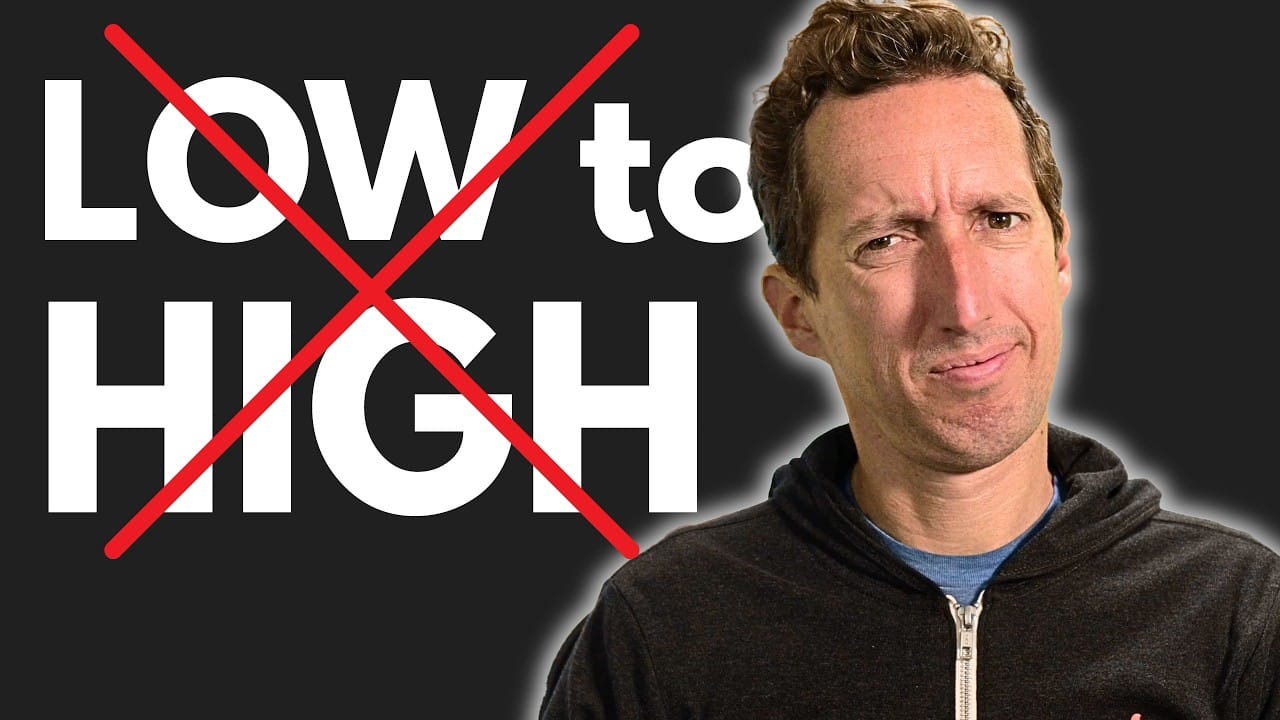
This two-to-threefold difference in steepness explains why generic 'low to high' instruction often fails. While both an 8-degree and a 24-degree swing are technically low-to-high, only the steeper path generates sufficient topspin for powerful, consistent shots with a high margin for error.
"An 8-degree upward swing and a 24-degree upward swing are both low to high, but they produce completely different amounts of spin, which means completely different amounts of curve and therefore completely different amounts of margin for error."
Exaggerated Shadow Swings Help Ingrain a Steeper Attack Angle for Topspin
To break the ingrained habit of a shallow, flat forehand swing, players can use exaggerated shadow swings to retrain their muscle memory. The drill involves making a relaxed swing while consciously dropping the racket head as low as physically possible before moving up towards an imaginary contact point. This extreme motion forces a much steeper angle of attack, in one case creating a 34-degree upward path, which is similar to that used for a heavy topspin lob.
While this exaggerated swing is not used for a standard groundstroke, it is a critical learning tool. By pushing far beyond the established comfort zone, it helps recalibrate a player's feel, making a more effective and steeper swing path feel normal during play.
"The point here is you always want to go way over away from your comfort zone first before meeting in the middle when you learn something new and unfamiliar."
Racket Face Angle, Not Swing Path, Determines Ball's Initial Trajectory
While a steep swing path is essential for creating topspin, it is the racket face angle at contact that dictates the ball's initial trajectory. Even with a perfect low-to-high motion, a slightly closed racket face will direct the ball into the net. Conversely, a slightly open face will ensure the ball clears the net, allowing the topspin to then curve it back down into the court.
This highlights a critical distinction: the path 'bends' the ball's flight, but the face 'sends' it on its initial line. The difference of just a few degrees in racket angle at impact separates a netted shot from a successful one, making face calibration a crucial skill.
"The face is what sets the starting trajectory of the ball. The one that went over the net had a slightly open face, and the one that went into the net had a slightly closed face."
To Improve on Court, Players Need Specific Targets, Not Vague Instructions
Common tennis instructions like "swing low to high" often fail to produce results because they are too vague. Meaningful improvement requires specific, concrete targets that give players a clear goal and instant feedback. Abstract concepts do not move the needle; actionable data does.
Instead of generic advice, players should focus on quantifiable goals, such as achieving a specific upward swing angle, and tangible feedback, like listening for the 'click' sound of topspin. This approach transforms learning from a process of guesswork into a focused effort with measurable outcomes.
"Vague instructions produce vague results. Amy didn't need to be told to swing low to high again. She needed to be told exactly how low and exactly how high."
Framework of 'The Face Sends It, The Path Bends It' Clarifies Topspin Mechanics
The mechanics of topspin can be simplified into a single framework: "the face sends it, the path bends it." The angle of the racket face at impact determines the ball's initial direction. The upward path of the racket through the hitting zone is what imparts spin, causing that initial trajectory to curve downwards.
This principle explains why a high follow-through does not guarantee topspin. The critical part of the swing happens before and at contact. If the racket's path to the ball is too flat, it produces a straight shot with little margin for error, no matter how high the swing finishes.
"The face sends it, the path bends it. Whatever the angle of the strings are facing at the moment of contact, that's the direction the ball starts traveling. And whatever direction the racket is moving when the ball touches the strings, that determines the spin."
Mastering Racket Path and Face Angle Unlocks Consistent Attacking Shots
By learning to independently adjust swing path and racket face angle, players can build a reliable system for hitting confident, attacking shots. Once a player can diagnose errors—adjusting the face to control trajectory and the path to control spin—they can consistently accelerate through the ball and curve it into the court. This turns hitting into a process of calibration rather than hope.
These two variables are the fundamental levers for all groundstrokes. Mastering their interplay allows a player to dial in any shot on demand, from a high defensive lob to a powerful down-the-line passing shot.
"By changing the angle of the face and the path of the racket, you can dial in literally any shot you want, forehand or backhand."
Also mentioned in this video
- The common tennis instruction "low to high" for topspin is incomplete, leading… (0:00)
- A student named Amy experienced common frustrations with hitting short balls,… (1:06)
- The first big mistake tennis players make when trying to hit more topspin is… (16:26)
- The second mistake is slowing down when the ball goes long, which actually… (17:37)
- The third big mistake is a fake low drop where the racket's circular loop is… (18:27)
- Viewers to hit 20 forehands focusing only on hearing the "click" sound, which… (21:04)
Summarised from Essential Tennis - Lessons and Instruction for Passionate Players · 21:24. All credit belongs to the original creators. Streamed.News summarises publicly available video content.