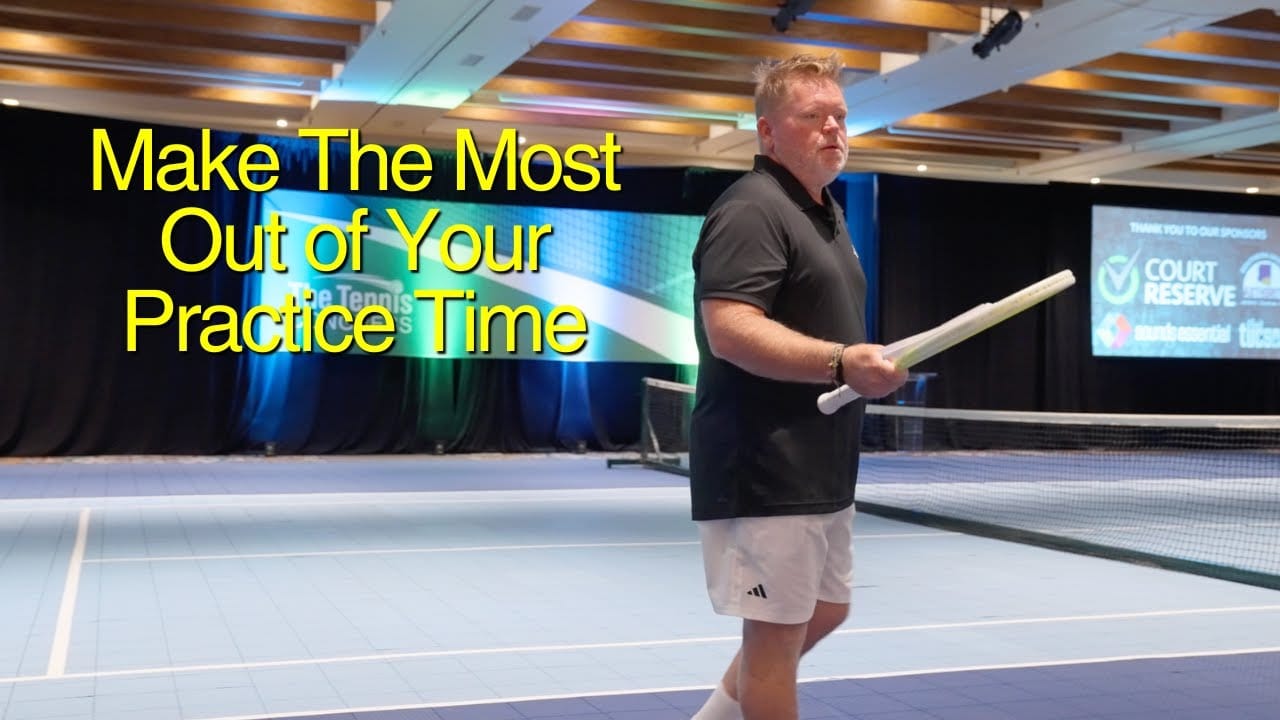
Original source: The Tennis Congress
This video from The Tennis Congress covered a lot of ground. Streamed.News selected 7 key moments and summarises them here. Everything below links directly to the timestamp in the original video.
To better handle pressure in your next match, try playing practice games where you only get one serve. This simple rule change can transform your ability to perform in key moments.
Tennis Coach Advocates 'Situational Point Play' to Simulate Match Pressure
Tennis coach Bill Riddle recommends using “situational point play” to build resilience and strategic thinking in practice. This method involves setting specific conditions before a point can be won or lost, such as requiring players to successfully hit four consecutive balls behind the service line before the point officially begins. Another common scenario is playing entire games or sets allowing only one serve, which immediately introduces a level of stress that mimics a real match.
The goal of these drills is to make players comfortable with being uncomfortable. By artificially creating high-stakes scenarios in a low-stakes practice environment, athletes learn to manage pressure and execute shots when it matters. This approach helps players develop the consistency needed to win points, which data shows are most often decided within the first four shots. It also forces players to think strategically, for instance, by hitting deep balls to push an opponent back and create attacking opportunities.
"I'm creating a situation in practice that makes him replicate the same thing he's going to have in a real match."
A Structured 30-Minute Tennis Practice to Maximize Efficiency and Skill
To make a 30-minute tennis practice session more effective, coach Bill Riddle advises a progressive structure that begins on a smaller court and gradually expands. Players should start at the service line, first hitting straight ahead and then cross-court. Only after establishing consistency in this shorter range should they move back to the baseline and repeat the process. This methodical progression helps build confidence and avoids the frustration that often comes from trying to rally from baseline to baseline immediately.
This structure also encourages players to use the court itself as a training tool. Riddle suggests using the alleys or the blue transition lines—typically used for 10-and-under tennis—as specific targets for shot placement. By aiming for these smaller zones, players can refine their accuracy for both singles and doubles play. This transforms otherwise ignored court markings into a set of cones, providing a clear objective and turning a simple hitting session into a focused, goal-oriented drill.
"Always and forever start short, start small, and then work from there."
Coach Recommends 'One-Ball Warm-Up' to Sharpen Tennis Focus
Tennis coach Bill Riddle introduced the "one-ball warm-up" as a simple but powerful drill to increase focus and simulate match conditions. The exercise is straightforward: two players warm up using only a single ball. If a player misses a shot, they are responsible for retrieving that same ball before play can resume. This simple constraint fundamentally alters the nature of the warm-up from a casual rally to a focused exercise.
The psychological effect is immediate. Unlike practicing with a full basket of balls where a miss is inconsequential, the one-ball rule makes every shot matter. Players become more "dialed in" because they want to avoid the tedious task of chasing down a stray ball. This heightened concentration naturally improves consistency and replicates the pressure of needing to keep the ball in play during an important point, forcing players to become comfortable with the uncomfortable aspects of competition.
"If I give you one ball, you do not want to go chase it. What are you doing? You're dialed in right now, aren't they?"
Make Ball Machine Practice More Realistic with Randomness and Angles
To get the most out of a ball machine, tennis coach Bill Riddle advises players to move beyond repetitive, single-location drills. Instead of placing the machine in the center of the court and feeding balls to the same spot, he suggests moving it to different positions to simulate realistic, cross-court angles. This better prepares players for shots they will actually face in a match, where the ball rarely comes from directly in front of them.
Furthermore, Riddle emphasizes using the machine's full capabilities to introduce unpredictability. By varying the speed, spin, and especially using any "random" setting, a player can practice reacting to different shots, just as they would in a real game. This approach aligns with his core philosophy of making practice uncomfortable. The goal is to avoid grooving a predictable stroke and instead build the adaptability required to handle the chaotic, random nature of a live tennis match.
"If you're not practicing against random, you're going to struggle. Random is what you're going to get in a match."
Tennis Coach: Serve One Extra Basket of Balls Each Practice to Boost Your Game
Tennis coach Bill Riddle shared a simple habit that can lead to significant improvement: serving one extra basket of balls every time a player goes to the court. He estimates this commitment takes only about 10 minutes but builds the repetition necessary for a more reliable serve. To further enhance performance under pressure, he advocates for playing entire practice sets using only one serve, a rule that forces players to develop a serve they can trust in critical moments.
These two techniques are designed to build mental and physical resilience. The repetitive nature of serving extra baskets develops muscle memory and consistency, increasing a player’s first-serve percentage. Meanwhile, the self-imposed pressure of the one-serve rule simulates the stress of a match. By getting comfortable in these difficult practice scenarios, players are less likely to be bothered by pressure during actual competition.
"The power in the one-ball warm-up and the power in the one serve... I'm going to play an entire set and I only get one serve."
Competitive Tennis Players Should Play Two Practice Matches a Week, Coach Advises
For competitive tennis players aiming to improve, coach Bill Riddle recommends playing a minimum of two practice matches per week. He distinguishes these from official league or tournament play, defining them as dedicated sessions where the primary goal is improvement rather than winning. Riddle suggests this frequency is the "bare minimum" required to see meaningful progress in one's game.
However, simply playing the matches is insufficient. Riddle stresses the importance of meticulously documenting the results in a journal. Players should record the score, what went well, and which areas of their game were weak. This creates a data-driven feedback loop, allowing players to track their improvement over time and identify specific skills to target in their next drills or practice sessions, making their training more focused and effective.
"If you're not playing two practice matches a week, you're just not going to get any better, at a bare minimum."
Pro Tennis Players Master Basics With Repetitive Drills, and Amateurs Should Too
Recreational tennis players often overcomplicate their practice, but they should instead emulate professionals by focusing relentlessly on the basics, says coach Bill Riddle. Having observed pros at major tournaments like Indian Wells, he notes they spend their time on repetitive, fundamental drills, such as hitting hundreds of balls cross-court or rallying exclusively into a small section of the court like the doubles alley. This dedication to simple repetition is what builds their formidable consistency.
This "keep it simple" approach is a key takeaway for any amateur player. Rather than seeking complex or flashy drills, Riddle advises picking one basic shot and practicing it until it becomes exceptionally reliable. Mastering a simple cross-court forehand or a consistent backhand down the line provides a player with dependable weapons they can trust under pressure. This foundational work, he argues, is far more valuable than having a wide variety of shots that are not consistent when a match is on the line.
"If the pros are out there doing the basics over and over and over... get really, really good at one of the basics."
Also mentioned in this video
- The need for specific targets to maximize the effectiveness of practice and… (2:12)
- The concept of 'pre-practice,' emphasizing the need to prepare both body and… (7:27)
- From matches and practice sessions, including strengths and weaknesses, scores,… (14:04)
- Bill Riddle explores the concept of an 'ideal practice,' emphasizing the… (20:42)
Summarised from The Tennis Congress · 43:04. All credit belongs to the original creators. Streamed.News summarises publicly available video content.