🌐 Also available in: 🇪🇸 Español
Original source: The Tennis Congress
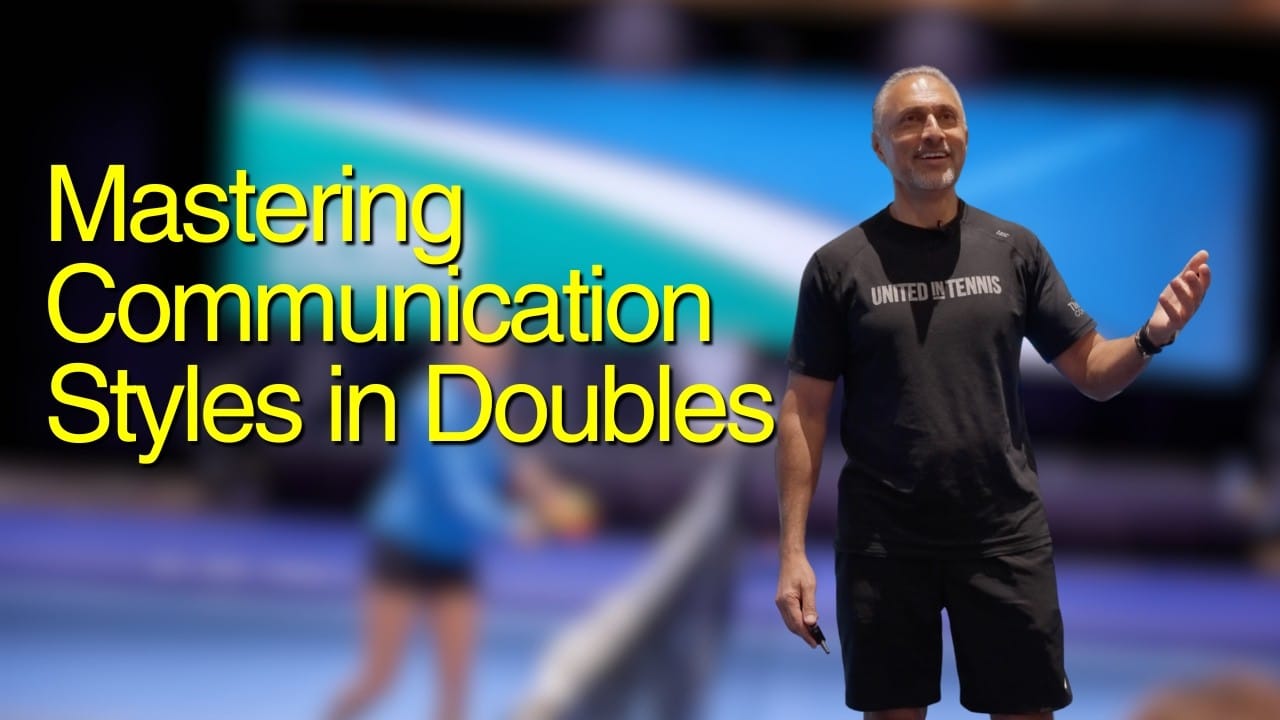
This video from The Tennis Congress covered a lot of ground. Streamed.News selected 8 key moments and summarises them here. Everything below links directly to the timestamp in the original video.
Want to stop spiraling with your doubles partner after a lost point? The key is to change one word: instead of saying what you *shouldn't* have done, state what you *needed* to do.
Tennis Coach Urges Players to Replace 'I Shouldn't Have' With 'I Needed To' Between Points
To improve on-court communication, coach Feisal Hassan directs players to reframe how they talk about errors. In a practice drill, he instructs the player who made a mistake to verbalize a constructive, forward-looking statement, such as “I needed to poach sooner.” This shifts the focus from a negative past action to a positive future adjustment. The partner’s role is to respond with simple, supportive encouragement like, “We got this next one,” rather than criticism or complex analysis.
This verbal discipline is designed to stop the negative emotional spiral that can derail a doubles team. By focusing on process over outcome, the practice helps partners maintain a productive dynamic under pressure. It transforms the crucial seconds between points from a period of potential tension into a brief, strategic reset, ultimately changing the team’s energy and improving resilience during a match.
"It's so easy to catch yourself using negatives. Notice how she changed the verbiage to 'I needed to go crosscourt' versus 'I shouldn't have hit it to the net player.' Everybody see the difference?"
Physical Connection Is Prerequisite to Good Doubles Communication, Says Coach
Before doubles partners can communicate effectively with words, they must first connect physically, according to coach Feisal Hassan. He demonstrated a mandatory four-step physical routine for players to execute between every point: find each other, make physical contact like a high five, walk together, and then get back into position. In a live drill, he had players practice only these movements without speaking, establishing the physical ritual as the foundation for everything that follows.
This non-verbal template is designed to prevent partners from drifting apart emotionally or physically after a point, a common habit at the amateur level. By creating a consistent, positive physical interaction, players reinforce their partnership regardless of the previous point's outcome. This ensures they are aligned and present as a team before they even begin to discuss tactics for the next point.
"We're not talking about what to communicate yet, we're just talking about the physical movement. Now we can talk about what to say."
How to Manage the 20-Second Clock and Opponent Complaints in Tennis
Coach Feisal Hassan offers a specific tactic for dealing with opponents who complain about slow play between points. He advises players to avoid a defensive or aggressive response and instead calmly acknowledge the 20-second rule. By saying, “Perhaps you are correct, are you aware we’re allowed 20 seconds?” and then inviting them to time the match, a player can shift the burden of enforcement onto the complainer. This often distracts the opponents, causing them to focus on the clock rather than their own game.
Beyond verbal tactics, Hassan highlights the power of body language in projecting control. He recommends that partners meet at the “T”—the intersection of the service line and center line—to communicate. This forward, central position presents a united and dominant front to opponents. This contrasts with players who turn their backs to the net or stand far apart. Such subtle uses of rules and positioning can create a significant psychological advantage.
"Are you aware we're allowed 20 seconds in between points? Feel free to time us. And if we take over 20 seconds, let us know, we'll give you the point."
How to Communicate With a Doubles Partner Who Resists Talking
When paired with a doubles partner who is reluctant to communicate, coach Feisal Hassan advises against making demands. Instead, he suggests using “empowering” language that frames the request around your own needs. Saying, “It really helps me calm down if we connect between points,” makes the partner feel helpful rather than criticised. This approach turns the request into an opportunity for them to support you, which is often more effective than demanding they change their behavior.
For players in leagues with frequently changing partners, Hassan recommends initiating a conversation about communication styles before the match even starts. Asking a simple question like, “How do you like to communicate?” can establish a baseline understanding and prevent on-court friction. This proactive dialogue allows partners to align on expectations and find a middle ground, building a more effective, if temporary, alliance.
"It would help me a lot. It stresses me a lot when I play. It would be helpful if it's okay with you that in between points we find each other. It really helps me calm down."
Deal With Emotion First, Tactics Second, Advises Tennis Coach
Doubles partners should address the emotional fallout from a lost point before discussing strategy for the next one, advises coach Feisal Hassan. He instructs that the initial moments after a point—the “find” and “connect” phases—are for supportive communication only. During this time, the player who erred should state what they needed to do differently, focusing on process (“I needed to poach”) rather than outcome. The partner's role is to read their teammate's body language and offer appropriate support, whether it's motivational, calming, or focusing.
Only after this emotional reset, when both players have mental clarity, should the conversation shift to tactics. Strategic discussions about opponents' patterns or upcoming plays are best reserved for the “walk together” phase of the between-point routine. By compartmentalizing communication in this way, teams can prevent lingering frustration from clouding their strategic judgment, leading to more effective and clear-headed play.
"You want to respond to what just happened. You're trying to relax. Now that you've got mental clarity from the previous point, you can move on to the next point. That's where you get to the tactical."
Research Shows Pro Tennis Players' Body Language Predicts Match Outcomes 75% of the Time
A player’s body language between points is a powerful predictor of success, according to research presented by coach Feisal Hassan. He cites studies of professional players in which observers could predict the match winner 75% of the time based solely on their non-verbal cues. Hassan also notes that research confirms more successful doubles teams consistently demonstrate higher levels of communication, directly linking interaction to performance.
Hassan categorizes team communication into four types: none, negative downward (a boss-to-subordinate tone), negative upward (excessive apologizing), and the ideal “positive horizontal.” He stresses that the goal is horizontal communication, which reflects a partnership of equals where feedback is collaborative and supportive. Avoiding hierarchical dynamics—where one player dominates or the other is deferential—is critical for building the trust and resilience needed to win matches.
"Pro players were observed in between points and they predicted from that body language 75% of the time who was going to win. That's research they've done."
On-Court Drill Reveals Striking Energy Shift Between Communicating and Silent Tennis Teams
To provide a tangible demonstration of communication's impact, coach Feisal Hassan conducted a side-by-side drill. He instructed one doubles pair to follow his template of finding, connecting, and talking between each point, while the opposing pair was told to remain silent and disconnected, as they had previously. Observers immediately reported a dramatic and visible shift in the on-court atmosphere.
The communicating team was described as having “higher energy,” looking more relaxed, and seeming to have “more fun.” In contrast, the silent team appeared “tense,” and onlookers felt they were watching “four individuals” rather than two integrated teams. The simple experiment provided a clear, real-time illustration of how deliberate, positive interaction transforms not only a team's strategic alignment but also its emotional state and on-court presence.
"Do you notice the difference in the energy? The first few points they played when they weren't communicating... you mentioned it was kind of tense."
Tennis Coach: Ban 'I'm Sorry' and Start Using 'We Need To'
Doubles players should eliminate the phrase “I’m sorry” from their on-court vocabulary, argues coach Feisal Hassan. He explains that apologies are unproductive because they focus on a negative past event and offer no solution for the next point. He advises players to instead use positive, instructional language framed around the team, such as, “Partner, I needed to move over,” or, “We need to...” This simple change shifts the focus from individual blame to a shared, actionable solution.
Hassan also stresses the importance of creating a unique team language, including motivational (“We are quick”), focusing (“Reset”), and calming (“It’s just tennis”) phrases. He warns that these must be agreed upon by both partners, recalling an instance where an older player’s well-meaning “It’s okay, kiddo” infuriated his younger teammate. Partners must collaborate to find words that build trust for their specific dynamic, ensuring communication helps rather than harms.
"If you screw it up intentionally, then you tell me you're sorry. If you didn't mean to screw it up, don't tell me you're sorry. You'd rather tell me something like, 'Hey, I needed to [do X].'"
Also mentioned in this video
- The concept of emotional baggage in doubles, emphasizing the difficulty of both… (0:00)
- The three skills in tennis (1:10)
- Feisal Hassan conducts a demonstration where players play doubles, and he… (1:58)
- Most emotional control is lost during the non-playing time between points and… (5:17)
- The common claim of good communication by demonstrating how players often… (7:22)
- Video examples contrasting typical player behavior after a point (picking up… (8:24)
- Feisal Hassan analyzes professional tennis players' behavior between points,… (9:59)
- A template for communication between points (11:24)
- Feisal Hassan details types of communication (16:41)
- Feisal Hassan concludes by reiterating the importance of movement patterns and… (40:20)
Summarised from The Tennis Congress · 42:04. All credit belongs to the original creators. Streamed.News summarises publicly available video content.