🌐 Also available in: 🇪🇸 Español
Original source: The Tennis Congress
This video from The Tennis Congress covered a lot of ground. Streamed.News selected 8 key moments and summarises them here. Everything below links directly to the timestamp in the original video.
If your tennis shots are suddenly falling short, the problem might not be your swing. Your strings lose their effectiveness long before they break, and replacing them could be the quickest fix for your game.
Tennis Players Urged to Treat Strings and Grips Like Car Tires for Better Performance
Players should prioritise fresh grips and strings over their racket frame, as these components are the critical points of contact, much like tires on a car. A live demonstration showed that polyester strings used for just 20 hours, though unbroken, were already “dead as a doornail,” meaning they had lost their elasticity and performance characteristics. This loss of life in a string can directly lead to a noticeable decrease in a player's depth and spin, causing them to compensate with more physical effort.
This insight challenges the common amateur focus on expensive rackets while neglecting regular maintenance. For a minor investment of around $40 for new strings or $3 for a new overgrip, players can resolve performance issues they might otherwise blame on flawed technique. Ignoring old equipment can not only hinder performance but also lead players to make unnecessary swing adjustments that could potentially cause injury.
"If you're feeling like, oh my depth isn't good, so I'm going to have to lift more... sometimes it's just a matter of 40 bucks for new strings. Rackets are important; strings and grips are more important."
‘Soft Poly’ Tennis String Myth Debunked; Harder Strings at Lower Tension Advised
The marketing claim that “soft” polyester tennis strings are inherently better for a player’s arm may be misleading. Softer polyester strings are more prone to notching, a condition where the main strings are grooved by the cross strings during impact. This grooving prevents the strings from sliding and snapping back into place, which is the key mechanism for generating heavy topspin, thereby negating one of the primary benefits of using polyester strings.
Instead of seeking out strings marketed as soft, players are encouraged to experiment with a harder, more durable polyester string strung at a lower tension. This combination can provide superior spin and feel without the premature notching of softer strings. For an even better result, a hybrid setup using natural gut in the main strings and a hard polyester in the crosses is recommended, as it allows the strings to slide freely against each other for maximum performance and comfort.
"If a poly is soft, maybe it starts notching because it's soft. So maybe a harder poly at a lower tension—I'd like you to experiment with that."
Slice Backhand and Split Step Are Key ‘Shortcuts’ to Better Tennis, Coach Argues
Contrary to the coaching cliché that “there are no shortcuts in sports,” certain techniques provide a disproportionate advantage and can be considered powerful shortcuts. Citing tennis analyst Joel Ducker, the speaker asserts that the slice backhand, often perceived as a difficult shot, is actually “the easiest shot in tennis.” Mastering it, along with fundamental grips like the continental for serves and volleys, can rapidly accelerate a player’s development.
The split step is another essential shortcut, especially for older or less agile players. The idea that performing a split step on every shot is excessively tiring is a myth. In reality, a well-timed hop helps a player react more quickly and stay balanced, preventing the awkward, jarring movements that often lead to back and hip injuries. This makes the split step a more efficient and biomechanically safer way to prepare for an opponent’s shot.
"When people think that [the slice backhand is] hard and coaches tell people, 'Yeah, slice backhands hard.' He's like, 'It's the easiest shot in tennis.'"
Tennis Is Only 25% Hitting, Coach Argues in Four-Step Workflow for Improvement
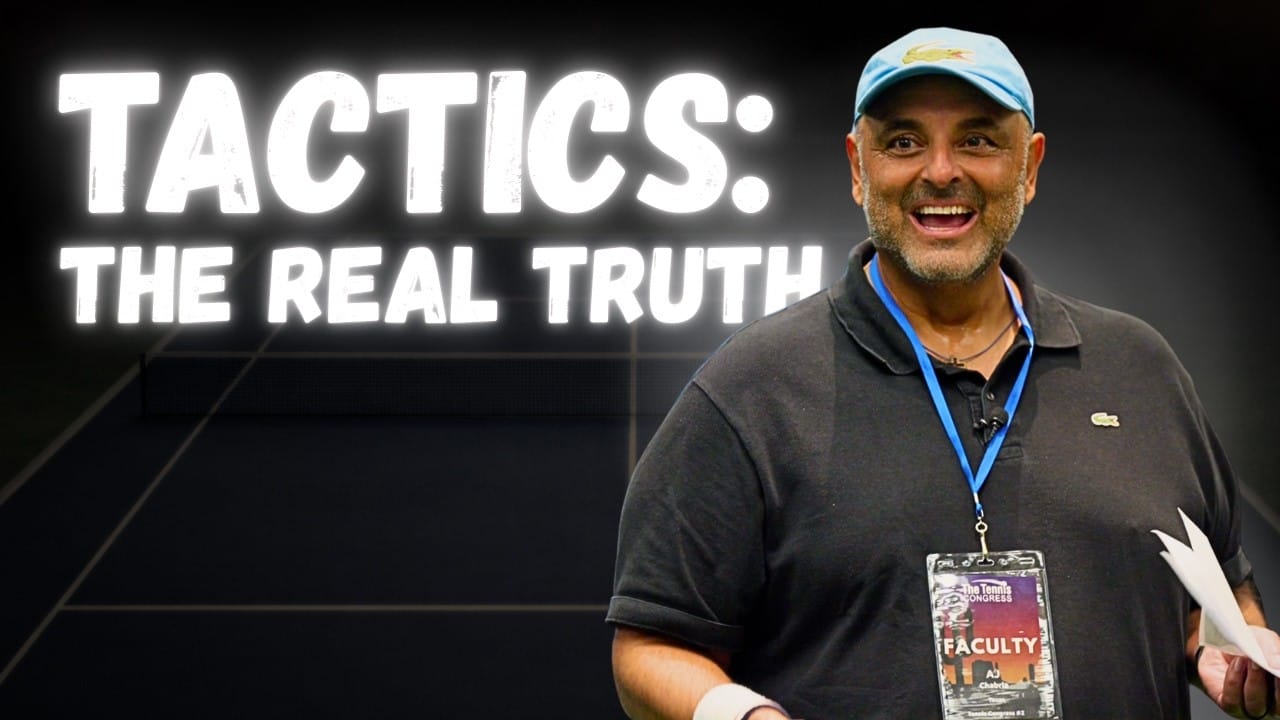
A tactical workflow for tennis proposes that the physical act of hitting the ball constitutes only 25% of a successful shot. The remaining 75% is divided equally among three other crucial phases: being ready and reading the opponent, prompt preparation of the racket, and balanced recovery after the shot. This framework encourages players to shift their focus from an obsession with stroke mechanics to a more holistic, process-oriented approach to the game.
By viewing each shot as a four-part sequence, players can more easily diagnose weaknesses in their game. For example, a weak backhand may not be a technical flaw but rather a symptom of consistently late preparation on that side. Allocating practice time to anticipation, early racket setup, and efficient movement can create the necessary conditions to execute a good shot, fundamentally reframing how players should approach improvement.
"I kind of wish that 'hit' was only 25% of the game, because the other 75% is the stuff that I need to do well so I can hit well."
Winning Tennis Requires Forcing Opponents Out of Comfort Zones and Mastering ‘Finishing Skills’
Beyond foundational tactics like consistency and depth, two additional strategies are essential for winning tennis matches. The third way to win is to actively “sabotage” an opponent by moving them and hitting shots into their least comfortable zones, such as high to their backhand or low with slice. This approach aims to disrupt their rhythm and exploit specific technical weaknesses, forcing errors rather than waiting for them.
The fourth strategy is the development of “finishing skills,” which are crucial for closing out points from an advantageous position. These skills include volleys, drop shots, and overheads—shots often neglected by players who exclusively practice from the baseline. Integrating half-court and net-play drills into practice is vital for sharpening these abilities, ensuring that offensive opportunities are converted into points won.
"The four ways to win are consistency, push them back, move them or sabotage them... and damn it, have finishing skills. Sharpen those skills."
Novak Djokovic’s Strategy to ‘Make People Suck’: Hit Deep Down the Middle
A key strategy for dominating tennis matches, perfected by Novak Djokovic, involves consistently hitting deep down the middle of the court. This tactic works by pushing opponents six to seven feet behind the baseline, which effectively neutralises their ability to create angles for offensive shots. By taking away the geometry of the court, a player can significantly reduce the threat posed by their opponent, regardless of how hard they hit the ball.
This approach is less about hitting winners and more about systematically making an opponent “play poorly.” It forces them into a defensive position where they must generate their own pace with no positional advantage. This deep-middle strategy turns a seemingly neutral rally into an offensive play, allowing the aggressor to control the point and dictate the flow of the match until an error or short ball is forced.
"Do what Djokovic has mastered, which is make people suck, make people play poorly by not giving them what they want, which is three steps of running and a gorgeous two angles. Don't give them that."
Myth of ‘No Shortcuts in Sports’ Debunked With Key Tennis Techniques
The long-standing coaching mantra, “there are no shortcuts in sports,” is a myth when applied to certain aspects of tennis. While it holds true for physical fitness and the sheer volume of practice required, specific technical and tactical elements can provide an immediate and significant advantage. These shortcuts are fundamental techniques that, once learned, dramatically improve a player's effectiveness on the court.
Among the most impactful shortcuts are learning the correct grips for different shots, particularly the continental grip for serves and volleys. Many players are not taught these foundational grips early on, leading to years of struggle with inefficient technique. Adopting the proper grip is not a long, arduous process but a quick adjustment that unlocks the potential for more powerful and consistent shots, proving that in technique, shortcuts do exist.
"Coaches have said there's no shortcuts in sports. And they're right when it comes to movement, fitness, reps... But I want to talk about the myth that there's no shortcuts in tennis."
Overly Aggressive Footwork a Myth for Adult Players; Timed Split Step Is Superior
The trend of promoting vigorous, high-energy footwork, exemplified by top players like Iga Świątek, is often counterproductive for adult amateur players. Believing the myth that more movement equals better readiness can lead to what is described as “bangy, vigorous footwork.” This approach, involving multiple, rapid-fire steps, can easily become mistimed, leaving a player flat-footed at the exact moment their opponent strikes the ball.
Instead of constant, high-intensity movement, a more effective shortcut is to focus on timing one or two split steps perfectly. A single, well-timed split step—a small hop as the opponent makes contact—ensures a player is balanced and ready to move in any direction. This method is more efficient, conserves energy, and ultimately improves reaction time far more than unstructured, excessive motion.
"If you're split stepping three, four times, there's a chance that one of your splits didn't hit when [your opponent] hit that ball. And if you're split stepping one or two times, there's a much better chance that you're timing your split better. And that is a shortcut."
Also mentioned in this video
- The presenter delves into the 'tenets' of the LPIT, focusing on the emphasis on… (0:46)
- The LPIT's customer service model prioritizes making players 'look good, feel… (1:52)
- Business strategies like replacing expensive pros with automated drones for… (2:26)
- The LPIT teaches in 'sound bites' and 'bumper sticker wisdom' like 'snap the… (3:34)
- The presenter transitions to discussing the actual title of the presentation,… (5:29)
- His tactical genius, particularly his ability to 'defy' and 'warp the… (6:08)
- The segment focuses on John McEnroe's quote, "probe, explore your opponent's… (7:34)
- The importance of having a clear game plan in tennis, contrasting it with the… (10:11)
- The presenter expresses admiration for Novak Djokovic's evolution, particularly… (11:34)
- The first way to win in tennis is consistency, which is a common answer but… (14:20)
- The presenter shares an Arthur Ashe quote about looking like a winner to gain a… (23:48)
- The 'snap the wrist' myth, explaining that the underlying biomechanics involve… (25:38)
- The myth that 'to be the best, you have to beat the best,' arguing that… (26:42)
- The concept of 'pressure is a privilege' from the Billy Jean King National… (28:37)
- Discussing tennis equipment, specifically rackets and strings, highlighting the… (32:26)
- The importance of correct grip size, debunking the old school wisdom and… (39:07)
- Elaborating on a previous LPIT tenet (40:37)
Summarised from The Tennis Congress · 42:31. All credit belongs to the original creators. Streamed.News summarises publicly available video content.