🌐 Also available in: 🇪🇸 Español
Original source: Essential Tennis - Lessons and Instruction for Passionate Players
This video from Essential Tennis - Lessons and Instruction for Passionate Players covered a lot of ground. Streamed.News selected 4 key moments and summarises them here. Everything below links directly to the timestamp in the original video.
The secret to a better forehand might not be more coaching cues, but fewer. Focusing on two simple principles—body rotation and a passive arm—can naturally correct complex swing mechanics.
The Foundation of a Fluid Forehand Begins with a Passive Arm
The foundational training phase for correcting a tense forehand begins with simple shadow swings from the service line. A player must focus on only two principles: using the body's rotation as the engine for the swing and allowing the hitting arm to remain completely passive and relaxed, as if it is just coming along for the ride.
This approach encourages a much longer and more fluid swing path—often double or triple the size of a tense, abbreviated stroke. By prioritising a relaxed arm over specific mechanical positions, many other complex elements of the swing resolve themselves naturally without conscious, inhibiting effort.
"When you let the arm relax and the body does its job, you will be shocked at all of the other auxiliary elements that naturally check themselves off."
Decoupling Swing Length from Tension Is Key to Effortless Power
In the second training phase, a player transitions from shadow swings to hitting balls, focusing on a single instruction: maintain the same passive arm sensation developed previously. The goal is to allow the arm and racket to move freely through contact as if the ball were not even there, preserving the fluidity of the motion.
Here's why this is difficult: many players subconsciously equate a longer swing with a faster, more intense one, which reintroduces tension. It is critical to understand that a long swing can and should be relaxed; breaking this ingrained habit is essential for developing an efficient, powerful stroke.
"Players generally equate length of swing with speed of swing. And it doesn't have to be that way. You can make a long swing and be relaxed."
The Paradox of Power: Accelerate the Body, Not the Arm
In the final training phase, a player learns to add pace by accelerating the rotation of the torso, not by tensing the arm. The objective is to increase the speed of the body's turn while consciously maintaining the same loose, fluid arm motion that was established in the earlier drills.
This presents a difficult challenge: it's a paradox to try harder while staying relaxed. Successfully managing this allows players to generate more power and spin without reintroducing the jagged, inefficient movements that come from muscular tension, achieving the fluid power seen in high-level tennis.
"It's a paradox to try harder and be loose. But if you can do it... it's the magic formula to be able to hit balls like the best players at your local courts."
Four Common Forehand Mistakes That Sabotage Control and Power
Four common mistakes work directly against the principle of a fluid, relaxed swing. These include trying to roll the racket over the ball to create topspin, using muscular tension to steer the shot, confusing a short swing with a controlled swing, and adding pace before a loose, flowing motion is established.
Paradoxically, these actions—all attempts to increase control—are the very things that decrease it. The harder a player tries to control the ball with tightness, the more jerky and unpredictable the racket path becomes. True precision and power come not from force, but from a repeatable, smooth, and fluid swing.
"The thing you're doing to keep the ball in play is the exact thing that's making you miss."
Also mentioned in this video
- Attempting to control, steer, and force a forehand in tennis creates tension in… (0:00)
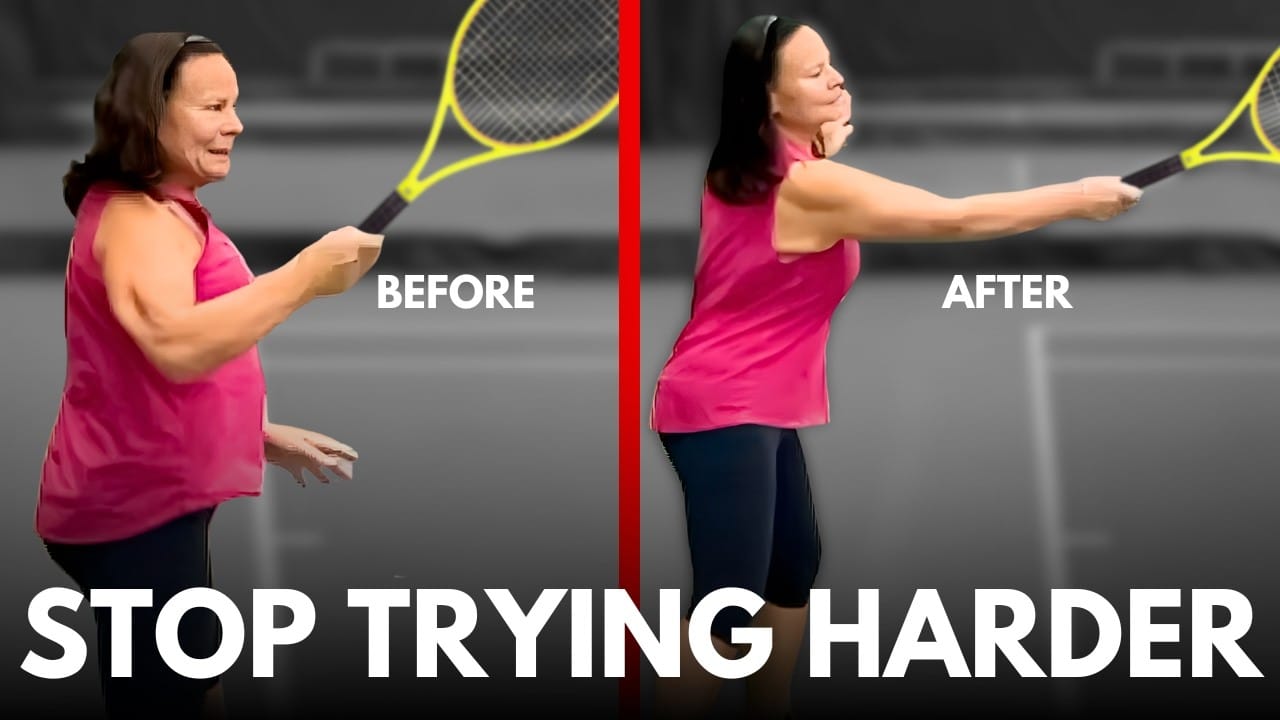
- An analysis of Melanie's forehand revealed that despite good body rotation, her… (1:01)
- Observing professional players like Roger Federer and Novak Djokovic reveals… (3:13)
- By hitting balls from a greater distance and faster pace, while focusing on… (10:41)
- The presenter uses the analogy of a duck swimming—calm and smooth above water… (19:53)
Summarised from Essential Tennis - Lessons and Instruction for Passionate Players · 21:45. All credit belongs to the original creators. Streamed.News summarises publicly available video content.