🌐 Also available in: 🇪🇸 Español
Original source: The Tennis Congress
This video from The Tennis Congress covered a lot of ground. Streamed.News selected 7 key moments and summarises them here. Everything below links directly to the timestamp in the original video.
Want to win more points at the net in doubles? The secret isn't just aggression; it's learning to recognize the specific moment your opponent is in trouble and can't hit down the line.
To Poach Successfully in Tennis, Think Like a Baseball Manager Using 'The Shift'
The optimal time to poach in doubles is when an opponent is in trouble and statistically unlikely to hit the ball down the player's alley, according to coach Christophe Delavault. He compares this strategy to the defensive "shift" in Major League Baseball, where teams reposition fielders based on data showing where a batter is most likely to hit. A tennis player is in "trouble" when they are stretched wide, hitting a high ball over their shoulder, or dealing with a very deep shot. In these situations, a cross-court return becomes the most probable outcome, creating a clear opportunity to intercept.
This approach reframes poaching from a purely reactive guess to a calculated, proactive maneuver. By learning to recognize the visual cues of an opponent in distress—what Delavault calls a "Zone A" situation—net players can commit to moving across the court before the ball is even struck. This increases the probability of a successful interception, turning a defensive scenario for the opposing team into a point-winning offensive play.
"If you can sniff out that that person cannot come down your alley, why should you stay? Obviously you want to leave."
A Simple Zone System for Tennis Doubles Dictates When Net Players Should Attack or Defend
A net player's decision to be aggressive should be dictated by where the ball bounces on the opponent's side of the court, explains coach Christophe Delavault. He outlines a system where if a ball lands in "Zone A"—deep in the court, putting the opponent in trouble—the net player should "pinch" the middle or poach, anticipating a weak or cross-court return. Conversely, if the ball lands in "Zone B"—a comfortable, mid-court position—the opponent is in control, making a down-the-line shot a real threat. In this case, the net player's primary duty is to hold their position and defend their own half of the court.
This framework simplifies the complex decision-making process at the net, transforming a player's role from reactive to predictive. By understanding that an opponent in trouble is unlikely to hit a powerful shot down the line, players can take calculated risks to intercept the ball. The system encourages constant analysis of the tactical situation, helping players anticipate the next shot based on the quality of their own partner's outgoing ball, rather than waiting to react after the opponent has hit their return.
"When the person's in trouble, that's when you can start to pinch or poach. Whenever your opponent is moving forward and in control, they can possibly go down your alley. So what do I do? I'm just responsible for my half of the court."
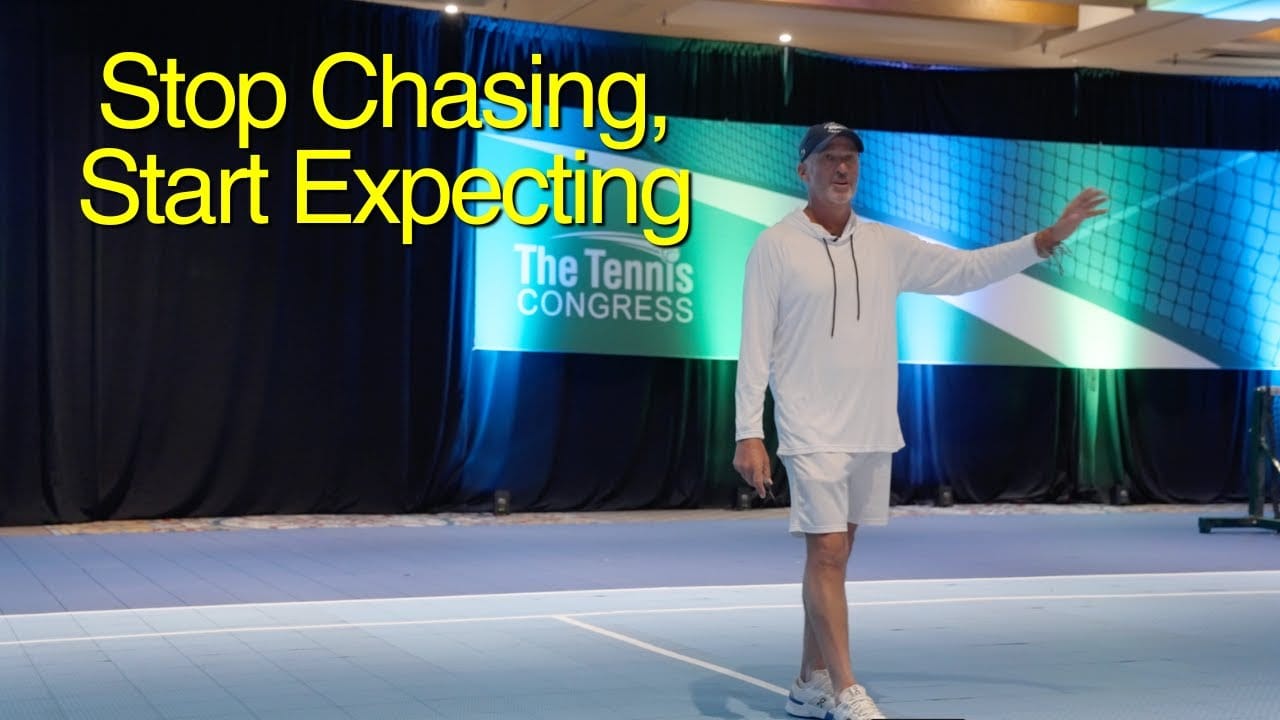
Stop Chasing, Start Expecting: A Zone System to Predict Your Opponent's Next Shot in Tennis
Baseline players can anticipate their opponent's return and position themselves proactively by using a four-zone system, according to coach Christophe Delavault. The strategy, adapted from work by Craig O'Shannessy, is based on observing where a player's own shot lands on the opposite side of the court. A shot landing in "Zone A" (very deep) will likely produce a weak, short return, signaling the player to move forward to attack. Conversely, a ball landing in "Zone B" (no-man's-land) gives the opponent control, telling the player to hang back and prepare to defend a stronger shot.
This method is designed to replace reactive "chasing" with predictive "expecting." By understanding the likely outcome of their shots before their opponent even makes contact, players can gain a critical advantage in court positioning. The system provides a simple heuristic: deep shots put you on offense, while mid-court shots require you to play defense. This allows players to dictate the flow of the point through intelligent movement, rather than simply reacting to the ball.
"If you hit into Zone A, then it's likely going to be short. Trend forward. If you give them a B and you're a baseline player, what do you do? You hang back."
Tennis Coach Details Two Counterintuitive Moves to Win More Doubles Points
Doubles players can gain a tactical edge by mastering two counterintuitive court movements, according to coach Christophe Delavault. The first is the "4 o'clock move": if you are at the net and your partner hits the ball to the opposing net player, you should immediately drop back diagonally toward "4 o'clock" to cover the short, angled volley, which is the most probable return. The second rule applies when your partner at the net gets into a volley exchange. Instead of staying back at the baseline, you should move forward, anticipating that a short ball will emerge from the rally for you to put away.
These specific plays underscore a broader strategic principle: move to where the ball is most likely to go next, even if the movement feels unnatural. The instinct when a fast volley exchange happens is often to stay back for safety, but moving in is the correct offensive play. Both tactics are based on anticipating the flow of the point multiple shots ahead, allowing a team to control the court through intelligent positioning rather than reacting to each shot as it comes.
"When your partner had a high ball to the net player, drop back to 4 o'clock... Whenever you see your partner engaged and you are at the baseline, move forward."
The Secret to Court Positioning in Tennis Isn't Following the Ball, It's 'Centering'
Effective court positioning in tennis relies on a concept called "centering," which means constantly moving to place yourself in the middle of your opponent's most likely range of shots, explains coach Christophe Delavault. He uses a soccer goalie analogy, noting that while a goalie's goalposts are fixed, a tennis player's "goalposts"—the opponent's possible shot angles—are always moving. As an opponent is pulled wide, for example, the center of their potential returns shifts dramatically, and a player must adjust their position to bisect those new angles.
This principle requires players to abandon the simple tactic of "following the ball" and instead engage in constant geometric calculation. For a baseline player, this often means moving in the opposite direction of their opponent. If the opponent is pulled wide to the left, the baseline player must move to their right to cover the new center of the court. This dynamic repositioning is crucial for anticipating the highest-probability shots and transforming defense from a reactive scramble into a proactive strategy.
"You always want to find yourself in the middle of your opponent's shot selection... The trouble is that the middle never stays in the middle of the court."
Doubles Strategy: How to 'Sandwich' the Court to Define Defensive Roles
In a one-up, one-back doubles formation, partners must often move in opposite directions to maintain proper court coverage, explains coach Christophe Delavault. As an opponent is pulled wide, the net player should follow the ball to cover the angle, while the baseline player must move away from the ball to defend the newly opened space. To clarify responsibilities on shots down the middle, he introduces the "sandwich" strategy. This concept divides the court diagonally, making the net player responsible for all short balls in their half (the top slice of the sandwich) and the baseline player responsible for all deep balls and lobs (the bottom slice).
This system provides a clear, visual model for how doubles partners can coordinate their movements and responsibilities without verbal communication. The "opposite movement" rule prevents both players from being pulled out of position together, maximizing court coverage. Meanwhile, the "sandwich" rule eliminates confusion over who should take short balls versus lobs, leading to more decisive action and fewer errors caused by hesitation or miscommunication.
"The court is to me cut in two halves, the sandwich... Any short ball right here, it's mine... If a ball or lob goes over there, it's a lot easier for [the baseline player] to get it."
The #1 Reason to Stand at the Service Line in Doubles: To Cover Your Partner's Mistakes
The primary reason a net player should stand at the service line when their partner is receiving serve is to defend against a potential error, advises coach Christophe Delavault. This conservative positioning anticipates the worst-case scenario: a weak, high return—a "floater"—that gives the opposing net player an easy put-away shot. By starting back from the net instead of close to it, the player is better prepared to handle this defensive situation and keep the point alive. This principle of preparing for a partner's mistake is a core tenet of sound doubles strategy.
This defensive-first mindset also informs how a net player should move during a rally. Delavault explains that, counterintuitively, the best position to defend against a hard-hit drive from the baseline is closer to the net, as it cuts down the opponent's angles and reduces reaction time. In contrast, the correct spot to handle an anticipated lob is back near the service line. Good net positioning is therefore not a static location, but a dynamic adjustment based on predicting both the opponent's intentions and the quality of your own partner's shot.
"There's one reason and one reason only why I start here: in case my partner screws up. What's the worst thing I want him to do? Hit a high floater to the net player."
Also mentioned in this video
- The concept of "stop chasing and start expecting" in tennis, explaining that… (0:00)
- His teaching philosophy, which is based on understanding the skills and… (1:16)
- An opponent's shot is primarily determined by what you give them, providing a… (3:01)
- The responsibilities and opportunities for Baseline players, which include… (7:54)
Summarised from The Tennis Congress · 45:31. All credit belongs to the original creators. Streamed.News summarises publicly available video content.