🌐 Also available in: 🇫🇷 Français
Original source: 2MinuteTennis
This video from 2MinuteTennis covered a lot of ground. Streamed.News selected 6 key moments and summarises them here. Everything below links directly to the timestamp in the original video.
Stop popping up your defensive half volleys. Understanding this simple principle of physics is the key to keeping the ball low and in play when returning a smash.
The Physics of the Half Volley: Why a Closed Racket Face Is Necessary to Counter an Overhead
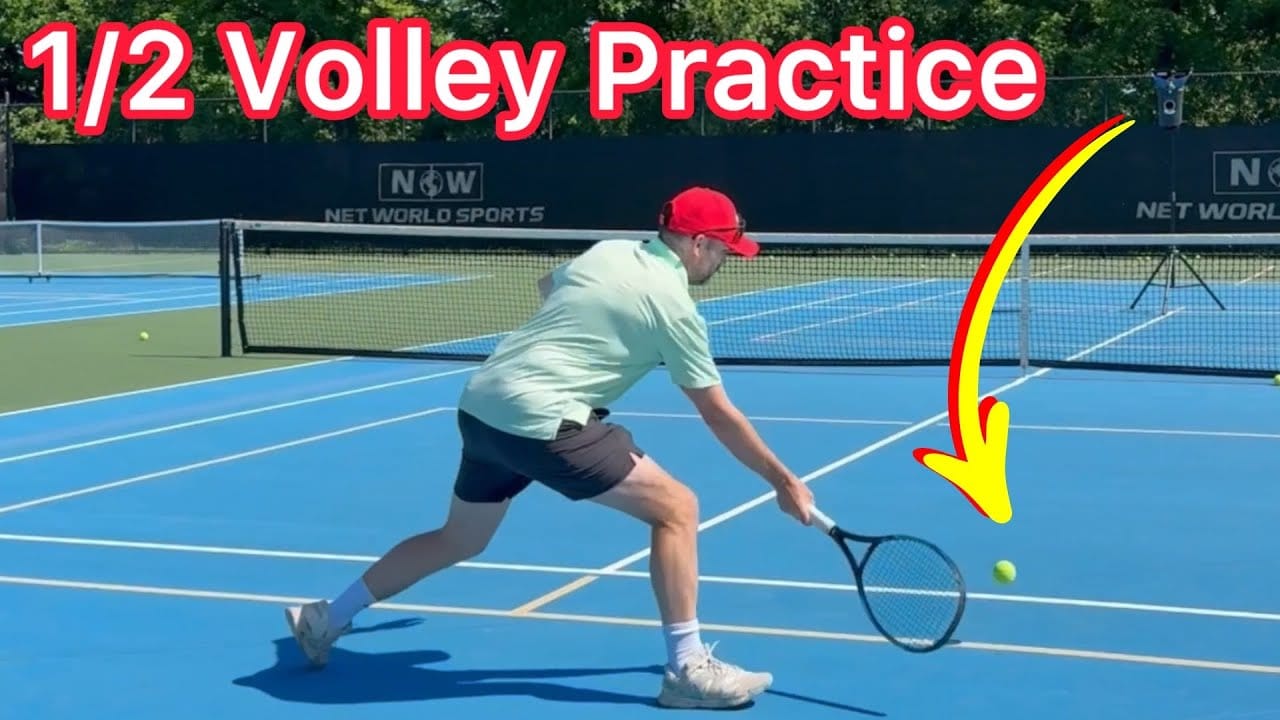
To control a half volley against an opponent's overhead, a player must present a slightly closed racket face at contact. A common error is keeping the racket face vertical, which, due to the principle of incidence and reflection, sends the upward-bouncing ball on an equally high trajectory, resulting in a popped-up return.
This counterintuitive adjustment is a biomechanical necessity. By closing the face, the player counteracts the ball's upward path off the bounce, redirecting its energy into a lower, more penetrating shot instead of an easily attackable lob.
"A vertical racket isn't good enough because the ball's going to come up and then leave at that same angle. What I actually have to do is close the face."
Fine-Tuning the Closed Racket Face Through In-Practice Calibration
Applying the theory of a closed racket face requires practical adjustment to find the correct angle for a low half volley. Initial attempts may result in closing the face too much, driving the ball into the net. This demonstrates that the technique is one of feel, not just a fixed mechanical position.
The goal is to calibrate the racket angle through repetition. By making subtle adjustments—opening the face slightly after hitting into the net—a player can develop the muscle memory to consistently execute a controlled, low return under pressure.
"Too much. No problem. Too much again, so I got to open it up again. There we go. Trying to keep the ball low."
How to Angle the Serve Stand to Simulate Overhead Shots
To properly practice returning an overhead, a ball machine must be angled to shoot downward. This is achieved by adjusting the mounting plate on the serve stand. By loosening two nuts on the head of the stand, the plate can be tilted forward to create the necessary downward angle for the machine.
Once the desired angle is set, the nuts are retightened to lock the plate in place. This transforms a standard horizontal feed into a realistic simulation of a high, descending smash, allowing for focused, match-specific drill work.
"You can see it's now pointing down at an angle so that the ball machine shoots down like an overhead."
Securing the Proton Ball Machine for Angled Overhead Drills
When mounting the lightweight Proton* ball machine on an angled serve stand, two components are critical for safe operation. First, a ball guard must be placed at the front of the machine to prevent balls from spilling out due to the downward tilt of the setup.
Second, a security strap is used to firmly attach the machine to a knob on the stand. This ensures the unit remains stable and cannot be knocked over, even when the stand is fully extended, providing a secure foundation for practice.
"There's a strap here that connects to this little knob on the back, and now it is not going anywhere. You can't knock it over."
Defensive Strategy: Why Retreating From an Overhead Is the Correct Tactical Play
Contrary to some advice, the correct strategy when facing an opponent's overhead is not to move forward and attempt to volley the ball out of the air. This approach is fundamentally flawed because it is impossible to predict the exact landing spot of a powerful smash, creating a high risk of being wrong-footed or injured.
The proper tactical response is to retreat, create space, and split step before the opponent makes contact. This defensive posture prepares the player to react and play the ball after it bounces, making the half volley the necessary and correct shot.
"When your opponent has an overhead, you're not supposed to move toward it and get that ball out of the air. You're going to get your teeth knocked out."
Finalizing Overhead Drill Setup by Adjusting Stand Height
After securing the angled ball machine and loading it with balls, the final step is to adjust the height of the serve stand. The stand is extended telescopically to an elevation that allows the ball to travel downward over the net, accurately simulating the trajectory of a real overhead from an opponent.
This height adjustment is critical for creating a realistic scenario. It ensures the player is practicing against a ball that descends sharply, replicating the difficult timing and low bounce characteristic of defending a smash in a match.
"Now, the ball is going to shoot down at an angle, and I can practice half volleys like I'm playing doubles."
Also mentioned in this video
- Practicing the half volley off an overhead, a shot difficult to practice alone,… (0:01)
- The versatility of the serve stand, noting it can be used for return of serve,… (0:33)
- The Proton's remote control capabilities via smartwatch, smartphone, or an… (3:43)
- The presenter starts the drill, noting a blinking light on the machine that… (4:26)
Summarised from 2MinuteTennis · 9:09. All credit belongs to the original creators. Streamed.News summarises publicly available video content.