Original source: Fault Tolerant Tennis
This video from Fault Tolerant Tennis covered a lot of ground. Streamed.News selected 5 key moments and summarises them here. Everything below links directly to the timestamp in the original video.
To fix your forehand, you might need to give your brain less information, not more. This drill isolates the single most important point of feedback to let your body teach itself.
Two-Finger, Open-Palm Drill Isolates Haptic Feedback to Rebuild Forehand Mechanics
A two-finger swing drill, inspired by the grip of Carlos Alcaraz, forces a player to rebuild their forehand feel from a single point of contact. The technique involves nestling the narrowest part of the handle into the V of the hand and hitting with an open palm. This method intentionally strips away all other haptic information, compelling the brain to process the racket's momentum through the one correct reference point.
The thesis here is that this sensory isolation induces goal-oriented self-organization. By providing the brain with a singular, high-fidelity data stream, the player’s swing mechanics naturally evolve toward a more efficient pattern without conscious technical thought, adapting to achieve the task of hitting the target.
"By taking away all of your haptic information except for that one point, I'm forcing you to perceive the racket's momentum through that."
Proper Grip Is Insufficient; High-Repetition Drills Required to Innervate Forehand Feel
Securing a correctly sized racket grip is a necessary but insufficient step for developing a high-performance forehand. Even with an optimal handle, the brain requires extensive, targeted repetition to utilize the available sensory information effectively. It is recommended to perform at least a thousand open-palm or other bottom-reference-removing swings over a month to forge this neurological connection.
What this means is that high-volume practice is essential to innervate the top of the hand, training the brain to feel and command the racket through its hitting slot. Without this dedicated motor learning phase, the neural pathways for fine control remain underdeveloped, regardless of how mechanically sound the grip is.
"Even once you have a grip that works... you're still going to need to do, over the course of like a month, at least a thousand of these kind of swings where we take away the bottom reference and force your brain to innervate the top of that bracket."
Forehand Self-Drop Serves as Litmus Test for Control System Development
A player's ability to simply self-drop a ball with their forehand grip provides a powerful diagnostic tool for their stroke development. This action serves as a litmus test: if a player can successfully rally using an open-hand drill but fails this simple task, it indicates that their fundamental biomechanics are sound but their neurological control system is lacking.
This distinction is critical because it isolates the problem, guiding the player's focus. The challenge is not to overhaul the swing's physical shape but to reintegrate the full grip while preserving the momentum pattern learned in the drill, bridging the gap between raw mechanics and fine motor control.
"The biomechanics are really, really good and the control system is really, really lacking."
High-Fidelity Haptic Feedback Enables Real-Time Forehand Correction with Novel Grips
The capacity for rapid, on-the-fly forehand adjustments is a direct function of the quality of haptic feedback from the hand to the brain. When a grip provides flush, continuous contact—especially from the bottom fingers and the top of the hand—it creates a high-fidelity data stream. This allows the brain's motor program to immediately correct for errors in timing and positioning, even when using an unfamiliar grip.
The thesis here is that skilled performance is not a rigid, pre-programmed action but a dynamic feedback loop. An effective grip is one that functions as a high-bandwidth sensor, empowering the motor control system to adapt in real time.
"The motor program that my brain is running is getting such high-fidelity input from the way that I'm holding the handle."
Loss of Top-Hand Haptic Reference Causes Catastrophic Loss of Racket Control
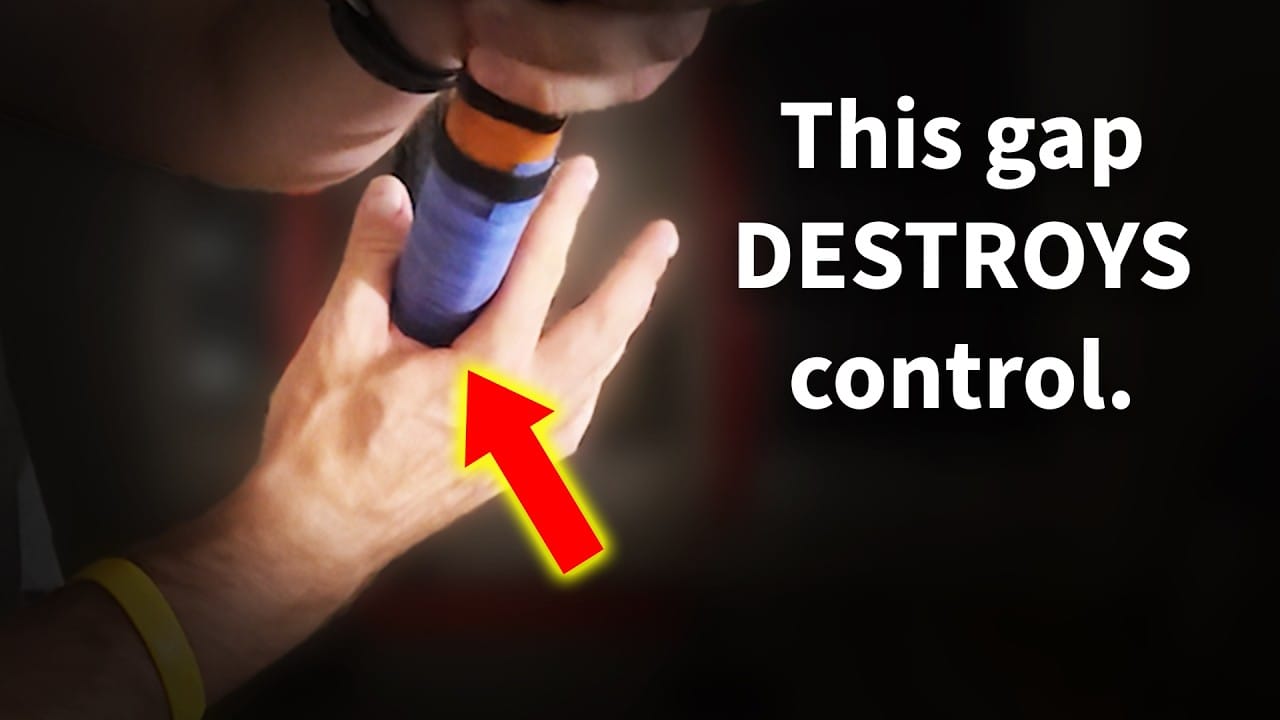
Disengaging the haptic reference point at the top of the hand, which simulates the effect of a grip being too large, leads to a severe and immediate degradation of racket face control. When a gap forms between the V of the hand and the handle, the player is rendered unable to perceive the racket’s pressure profile through the swing. This critical sensory deprivation makes it impossible to manage the swing's loading phase or time its release accurately.
Another way to say this is that the top of the hand functions as an indispensable sensor for the kinetic chain. Without its input, the motor program operates blindly, unable to modulate the forces that determine shot accuracy.
"If I can't perceive the pressure profile through here, then I have no idea if I'm even getting the load that I'm looking for. And then number two, I have no idea where the load is releasing."
Also mentioned in this video
- If the tennis racket handle is too big, a player cannot properly perceive… (0:00)
- Many students struggle with proper haptic feedback due to an overly thick grip,… (1:47)
Summarised from Fault Tolerant Tennis · 8:20. All credit belongs to the original creators. Streamed.News summarises publicly available video content.