🌐 Also available in: 🇫🇷 Français
Original source: 2MinuteTennis
This video from 2MinuteTennis covered a lot of ground. Streamed.News selected 4 key moments and summarises them here. Everything below links directly to the timestamp in the original video.
Use this specific, repeatable drill at home to build the muscle memory required for a balanced and powerful net approach.
How to Master the Front Foot Hop with At-Home Drills
Players can develop the front foot hop technique through simple, off-court practice using a training aid like the Topspin Pro. The drill involves a four-part sequence: turn and prepare, step onto the front foot to lean into the shot, strike the ball, and immediately hop on that same front foot. After the hop, the player then jogs forward to simulate continuing to the net, building the complete movement pattern.
This hop is a biomechanical necessity, not an optional flourish. It allows the lower body to maintain forward momentum while the rear leg kicks back as a natural counterbalance to the forward arm swing. This preserves balance and ensures a smooth, controlled advance toward the net.
"You'll step onto the front foot, and as you hit, this back leg kicks behind, so you just hop on the front foot to keep the lower body moving with the upper body, so that you stay balanced."
The Biomechanics of the Front Foot Hop for Net Approaches
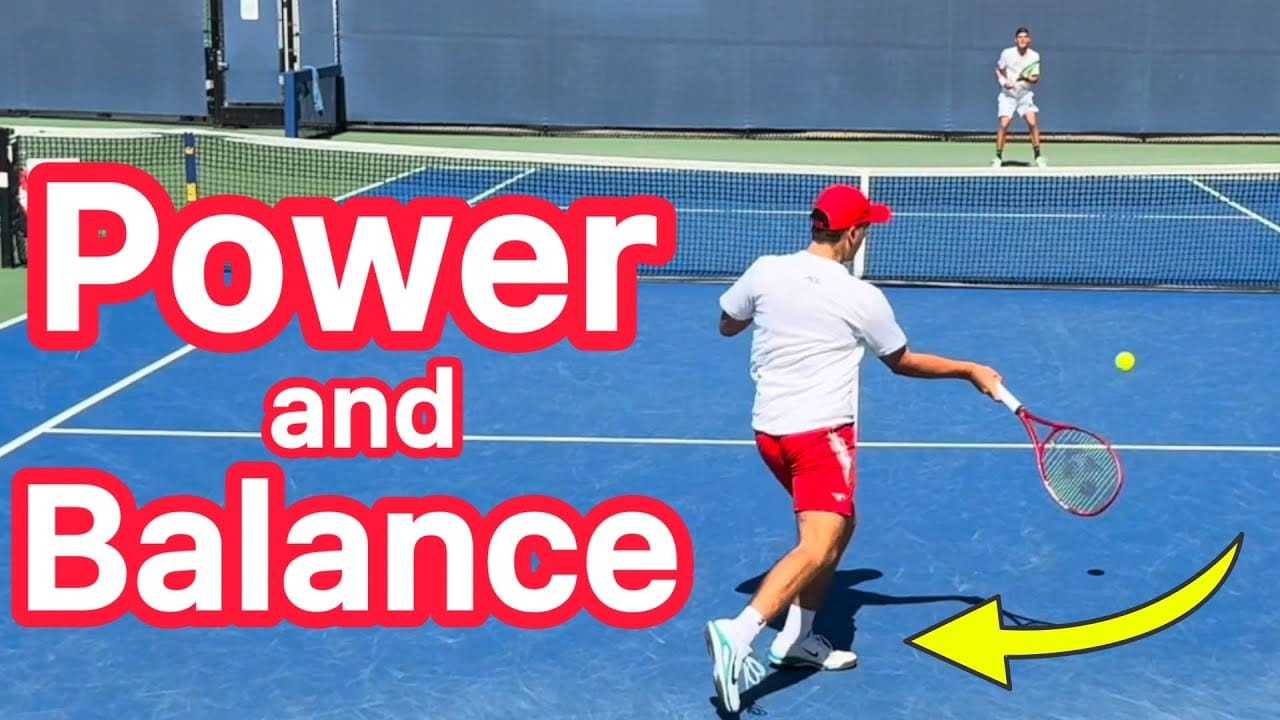
The front foot hop is the preferred footwork for players approaching the net at a slow or moderate speed. The technique requires a player to step onto their front foot just before contact and then hop on that same foot immediately after, resulting in two consecutive steps with the lead foot. This can be observed in high-level players on both forehand and backhand approaches.
This movement is a direct consequence of physics. As the hitting arm swings forward, the opposite-side leg naturally kicks backward as a counterbalance. The hop is critical to keep the player's center of mass moving forward, preventing them from losing balance during this momentary opposition of forces.
"If he does not hop with his left foot, he's going to fall flat on his face. While his body is wasting time waiting for that right leg to kick behind, his brain says, 'let's hop on that left foot again to keep our lower body under us.'"
Off-Court Repetition Is Crucial for Mastering Net Approach Footwork
Mastery of the front foot hop for on-court situations requires dedicated practice in a controlled, off-court environment. Players should repeatedly perform the sequence: step onto the front foot, hit, hop on that same foot as the rear leg kicks back, and then continue forward. This can be done in any small space, like a garage or basement, without needing a full court.
This footwork is specifically designed for slow to moderate speed approaches. It is not the correct technique for sprinting to the net, but it is essential for maintaining balance and control during more deliberate transitions from the baseline.
"You have to practice things off court so that you can master them on court."
Analysis of Elite Players Reveals Subtle but Critical Approach Footwork
Close observation of high-level players reveals subtle techniques, like the front foot hop, that are fundamental to their success but often go unnoticed by the average viewer. This specific footwork is not limited to one stroke; it is a universal mechanic used for both forehand and backhand approaches when moving toward the net at a moderate pace.
Mastering this sequence is therefore essential for any player looking to build a proficient transition game. The pattern of stepping onto the front foot, hitting, hopping, and continuing forward is a cornerstone of controlled, effective net play.
"The footwork when moving slowly or at a moderate speed is step onto the front foot, hit, hop on that same foot, and then continue going to the net."
Also mentioned in this video
Summarised from 2MinuteTennis · 6:55. All credit belongs to the original creators. Streamed.News summarises publicly available video content.