🌐 Also available in: 🇫🇷 Français
Original source: 2MinuteTennis
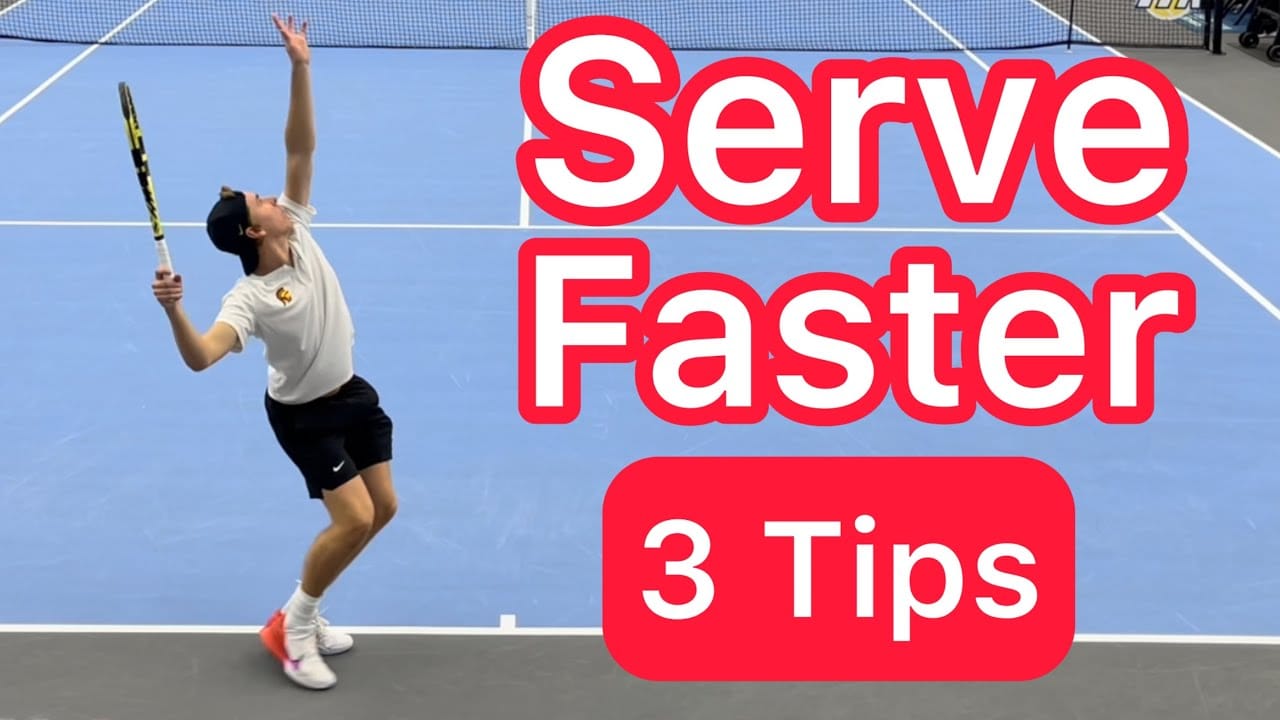
This video from 2MinuteTennis covered a lot of ground. Streamed.News selected 5 key moments and summarises them here. Everything below links directly to the timestamp in the original video.
If you use a pinpoint stance, timing your back foot with your toss is essential for power. Visualising a string between your tossing wrist and back ankle can help synchronise the motion.
Synchronise Tossing Arm and Back Foot to Accommodate a Lower Serve Toss
To successfully implement a lower toss, players using a pinpoint stance must bring their back foot up much sooner. Analysis reveals that professional Jannik Sinner takes just 0.21 seconds to position his back foot after the toss begins, compared to an amateur's 0.63 seconds. This timing is critical, as the upward explosion into the serve cannot begin until the back foot is set.
The solution is to coordinate the tossing arm and the rear foot. A useful drill involves imagining a string connecting the tossing wrist to the back ankle, so as the arm lifts to toss, it simultaneously pulls the back foot forward into position for a timely launch.
"I want you to imagine there is a string tied between the left wrist and the right ankle. As you toss, I want your back foot coming up. This will allow your body to be ready to explode up with that lower toss."
Correct Serve Follow-Through Finishes with Strings Facing Sideways, Not Down
A key indicator of an efficient serve is the racket's orientation after contact. For a right-handed player, the strings should face off to the right, regardless of the serve type—flat, slice, or topspin. This sideways finish is the natural outcome of proper pronation and internal shoulder rotation through the impact zone.
A common error is finishing with the strings pointing toward the knees, a motion driven by excessive wrist flexion. This incorrect follow-through inhibits racket-head speed, whereas proper rotation through the shoulder provides the mechanical path for maximum power.
"When you're done serving... your strings should not be pointing at your knees... You should be pronating and internally rotating your shoulder so that your strings face off to the right."
A Lower Serve Toss Forces a Faster Racket Speed, Analysis Shows
To increase serve speed, players should use a lower ball toss, creating a shorter time window for the swing. Analysis shows the optimal time from the toss reaching nose height to ball contact is between 0.6 and 0.9 seconds. Professionals like Jannik Sinner (0.76s) and Benoit Paire (0.66s) operate within this range, while amateurs often take longer, around 0.96 seconds.
This shorter duration is not a limitation but a necessary constraint for generating power. By giving yourself less time to complete the motion, you are biomechanically forced to accelerate the racket more quickly, which translates directly to a faster serve.
"The lower you toss, the less time you have, and it necessitates racket speed. So, you would instantly start serving faster if you just gave yourself less time to swing."
An 'Early Racket Drop' on the Serve Is Caused by a High Toss, Not a Flawed Swing
The common serving flaw known as an "early racket drop" is typically a symptom of a ball toss that is too high, not an incorrect arm path. The ideal sequence involves the body exploding upward just before the racket reaches its lowest point over the head. A high toss introduces a delay, causing the racket to drop too soon relative to the body's upward drive.
This mistiming prevents the player from maximizing the stretch-shortening cycle in the shoulder. A correctly timed motion—with the body driving up against the dropping racket—creates powerful external rotation and elasticity, which is key to a high-velocity serve.
"If you've been told that you have an early racket drop, what you actually have, most likely, is a toss that is too high, which means it allows the racket to leak down by the time you explode up."
Pinpoint Stance Servers Must Quicken Back-Foot Movement for a Lower Toss to Succeed
For players using a pinpoint stance, lowering the ball toss cannot be an isolated adjustment; it requires a corresponding acceleration of the back foot's movement into position. A player cannot begin the upward drive into the ball until that back foot is planted. Maintaining a slow foot-plant time while lowering the toss will cause late, low contact.
It is therefore critical to bring the back foot up sooner to match the reduced flight time of the ball. This synchronisation ensures the body is loaded and ready to explode upwards to meet the ball at its optimal height.
"Whenever we lower the toss for a pinpoint stance server, we have to bring the back foot up sooner."
Also mentioned in this video
- The video will provide three simple tips to Oscar Weightman, a 700-ranked… (0:00)
- An early racket drop is discussed as a byproduct of a high toss and late leg… (5:24)
- The first tip is reiterated (9:41)
- The third tip is re-emphasized (12:59)
Summarised from 2MinuteTennis · 14:30. All credit belongs to the original creators. Streamed.News summarises publicly available video content.