🌐 Also available in: 🇪🇸 Español
Original source: Essential Tennis - Lessons and Instruction for Passionate Players
This video from Essential Tennis - Lessons and Instruction for Passionate Players covered a lot of ground. Streamed.News selected 8 key moments and summarises them here. Everything below links directly to the timestamp in the original video.
To fix your serve's power leaks, start without a ball. A simple shadow swing with a balance pause can rewire your body's momentum for a more athletic, forward-driving motion.
Foundational Serve Training Begins with a 'Balance Pause' Shadow Swing
The first phase of rebuilding a powerful serve involves a simple shadow swing at half speed, culminating in a balance pause. The player practices landing on their front foot with the torso leaning forward and the back leg extending behind as a counterbalance. This drill forces mindfulness of body position and begins rewiring the player's momentum to flow forward into the court.
This exercise fundamentally reformulates the direction of energy. By forcing a pause, it reveals any imbalance, correcting the inefficient habit of sending energy sideways instead of directly toward the target, which previously hamstrung a player's ability to deliver their full power.
"I love the pause here in this training because what it does is it forces the player to be mindful of, am I actually counterbalancing or not?"
Integrating the Ball Requires Adjusting Toss Location Forward
The second phase of training introduces hitting the ball after performing shadow swings. Initially, players often revert to old habits, demonstrating a disconnect between the new body motion and the act of striking. The key adjustment is to gradually push the toss location further forward, by as much as a foot and a half, to align with the new forward-leaning body position.
This change is critical because the old toss, typically located directly overhead, only makes sense for an inefficient, vertical motion. A forward toss facilitates and encourages the body's momentum to transfer into the court, unlocking greater power.
"His serve motion was no longer straight up and straight down, so it no longer made sense to have the ball literally directly over his head."
'Pitcher Finish' Technique Adds Weight and Aggression to Spin Serves
The principles of forward momentum and counterbalance are not limited to flat serves. This technique can be adapted for spin serves by maintaining the forward body transfer—the "pitcher finish"—even with a more sideways swing path. The toss remains further in front than a traditional spin serve toss, allowing the body to drive into the court after contact.
Applying this forward lean, as demonstrated by players like John Isner on his kick serve, makes spin serves heavier and more aggressive. It combines the benefits of spin with the power of forward momentum, creating a much more formidable weapon.
"He can apply this same principle of getting more momentum, more energy into the court to a spin serve... to make them more heavy, to make them more aggressive."
Baseball Pitching Motion Reveals the Key to a Powerful Tennis Serve
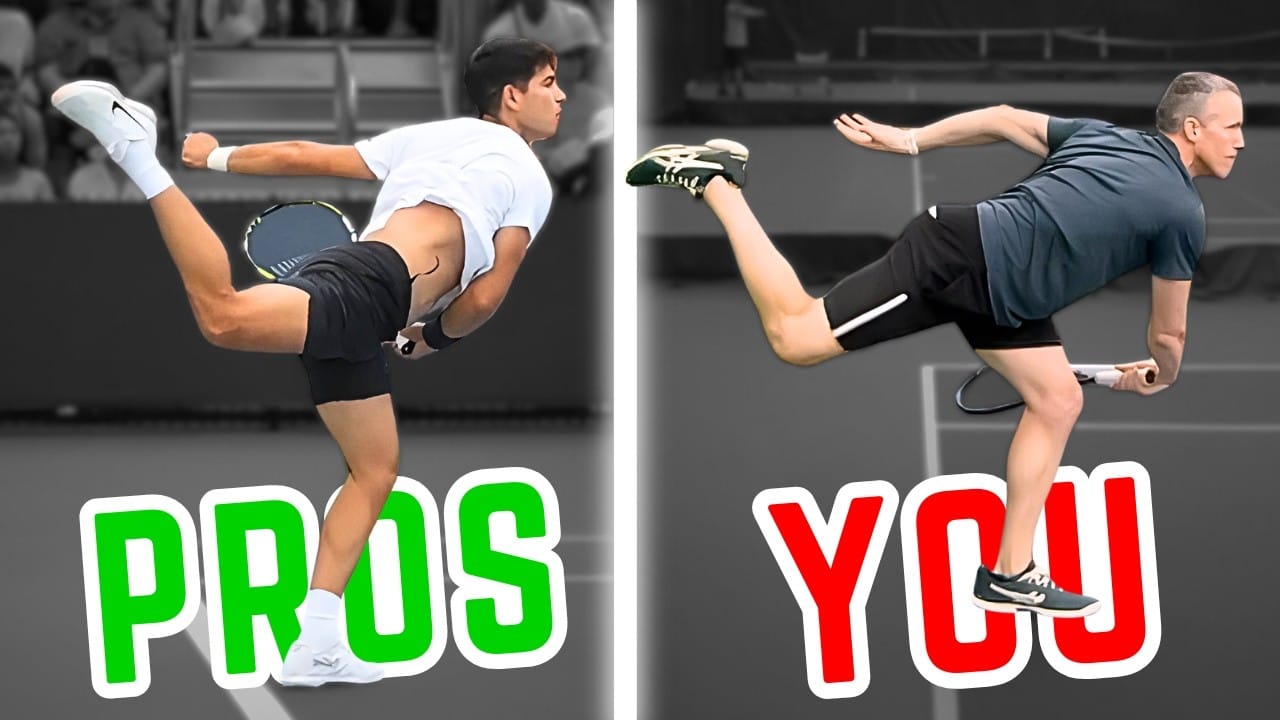
The mechanics of a powerful tennis serve mirror those of a world-class baseball pitcher. The critical element is the "pitcher finish," where the torso leads the motion and drives energy toward the target. After contact, the body continues to lean forward into the court, while the back leg kicks up to provide an essential counterbalance.
This forward lean and counterbalance are not stylistic choices but a fundamental mechanism for generating maximum velocity. This principle applies across all elite servers like Carlos Alcaraz, demonstrating that harnessing the entire body's kinetic chain is non-negotiable for power.
"Every elite server in the world, without exception, has a forward lean of the torso and the back leg providing counterbalance. The pattern is identical across all of them."
Gradual Acceleration Is Crucial to Cementing New Serve Technique
Once the new, athletic motion feels smooth at half speed, the next phase is to add acceleration incrementally. Instead of jumping from 50% to 100% intensity, players should increase their effort in 10% steps, moving from five out of ten to six, then seven, and so on. This allows for monitoring the quality of each repetition to ensure the new form holds.
This gradual approach is critical because a sudden burst of full-speed effort will almost certainly trigger a reversion to ingrained, less efficient habits. Methodical increases in speed ensure the new, correct pattern is maintained as power is added.
"It's critically important that you don't get super excited and stomp your foot on the gas pedal, because you'll almost certainly go back to your old habit."
Rushing to Full Intensity Sabotages New Serve Habits
A common mistake when learning new serve mechanics is immediately trying to swing at full intensity. This approach is counterproductive because the body defaults to its most familiar, ingrained patterns when attempting to generate maximum speed. True change requires retraining movements and habits at a slower pace first, allowing new patterns to form.
Swinging at half speed is not about hitting softly; it is about building the foundation and consistency of the correct new motion. Only after this new pattern is established should acceleration be introduced incrementally.
"When you keep your intensity high and you're swinging fast... your body just goes into habit mode and it's just going to pull the most familiar serve that it knows to the front of your brain."
A Five-Shadow-Swing Challenge to Ingrain a Powerful Serve Finish
To begin implementing a more athletic serve, players can start their next practice with five simple shadow swings. The focus should be on executing the full motion, landing on the front foot (left foot for a right-handed player), and holding the balance with the back leg extended behind. This drill helps internalize the feeling of the body driving forward into the court.
After completing the shadow swings, players should hit serves and listen for the distinct "pop" sound of clean, powerful contact. This auditory feedback confirms the successful transfer of forward momentum through the ball.
"Feel what it's like to let your body actually drive forward towards the net the way that it's supposed to to hit a big first serve. Then hit some serves and listen for that sound."
An Incorrect Toss Location Can Inhibit an Athletic Serve Motion
A frequently ignored but critical error is failing to adjust the toss location when learning a new serve. A toss placed directly over the baseline is only compatible with a straight up-and-down motion. It actively prevents the body from achieving the forward lean necessary for a powerful, athletic serve, effectively locking a player into their old, inefficient mechanics.
The toss must be placed in a position that facilitates the desired body movement. For a big, flat serve that drives into the court, the toss must shift forward to lead the body and allow it to transfer energy efficiently.
"The ball's location needs to be placed in such a way that it allows the body to move freely and smoothly and efficiently and athletically. His old toss fit his old motion, but his old toss would not have worked with the new way I was trying to get him to transfer his energy."
Also mentioned in this video
- Scott's original tennis serve, highlighting his body's straight up-and-down… (0:00)
- Scott's original serve, despite being consistent and having great spin, was too… (0:40)
- The difficulty of breaking old, comfortable habits even for natural athletes,… (7:10)
- The first big mistake players make is focusing only on the vertical part of the… (16:07)
- Scott's transformation demonstrates that achieving huge power on a serve is… (19:53)
Summarised from Essential Tennis - Lessons and Instruction for Passionate Players · 22:16. All credit belongs to the original creators. Streamed.News summarises publicly available video content.